
Writen by
Zain Zakir

Most brands hire an Amazon PPC agency at exactly the wrong time. Either too early—when they don’t have enough data or scale to justify the cost—or too late—when they’ve already burned six months trying to do it in-house without the right infrastructure.
The decision isn’t about whether agencies are “worth it.” It’s about whether your business is at the stage where external PPC management drives measurable ROI, or whether you’re better served building internal capability and keeping margin in-house.
At $5M–$20M in Amazon revenue, this decision matters. Hiring the wrong agency costs you 6–12 months of momentum, thousands in management fees, and the opportunity cost of not addressing the real bottleneck in your advertising. Building in-house at the wrong time means you’re stuck with an overstretched team that can’t execute at the level your business needs.
This post breaks down the framework top brands use to evaluate agency vs. in-house—not based on opinions or case studies, but on the operational realities of scaling Amazon PPC profitably.
The Real Question: Are You Solving for Expertise or Execution?
Most brands approach the agency vs. in-house decision from the wrong angle. They ask: “Can an agency get better results than we can?”
That’s the wrong question. The right question is: “Are we failing because we lack expertise, or because we lack execution bandwidth?”
These are two fundamentally different problems:
- Expertise problem: You don’t know what good PPC looks like. You’re not sure how to structure campaigns, when to negative keywords, or how to balance discovery vs. profitability. You need someone to teach you the playbook.
- Execution problem: You know what needs to be done, but your team doesn’t have the time or infrastructure to do it consistently. You need more hands and better tooling.
If you’re solving for expertise, an agency makes sense—but only if they’re actually going to transfer knowledge, not just run your account in a black box.
If you’re solving for execution, you need to evaluate whether an agency’s infrastructure is better than what you could build in-house. And at $5M–$20M in revenue, the answer depends entirely on your margin structure and growth trajectory.
The worst outcome? Hiring an agency to solve an execution problem when your real issue is strategic clarity. You’ll get better campaign hygiene, but you won’t get better results—and you’ll spend $5K–$15K/month to learn that lesson.
When In-House Makes More Sense: The Three Conditions
Building PPC capability in-house is the right move when three conditions are true:
1. You Have Margin to Reinvest in Team and Tooling
In-house PPC isn’t cheap. You’re not just hiring a specialist—you’re building infrastructure.
Here’s what it actually costs:
- A full-time PPC specialist: $60K–$90K/year (all-in with benefits)
- PPC software and tooling: $500–$2,000/month (Helium 10, Pacvue, Perpetua, Teikametrics, or similar)
- Training and onboarding: 3–6 months before they’re fully productive
All-in, you’re looking at $75K–$110K/year in direct costs, plus the opportunity cost of building infrastructure instead of just plugging into someone else’s.
If your Amazon business is generating 15%+ net margin and you’re confident that better PPC execution will add at least $150K–$200K in annual profit, the math works. If not, you’re better off with an agency that spreads infrastructure costs across multiple clients.
Rule of thumb: If you’re doing less than $10M in Amazon revenue or operating below 12% net margin, in-house PPC is a risky bet.
2. You Can Commit to Consistent Execution (Not Just Good Intentions)
Amazon PPC doesn’t reward intensity—it rewards consistency. Weekly search term reviews, monthly campaign audits, quarterly strategy resets. If you skip two weeks because your team is slammed with inventory issues or a product launch, your PPC performance degrades fast.
Most brands underestimate this. They hire a PPC specialist, load them up with responsibilities (catalog management, promotions, customer service overflow), and then wonder why campaigns aren’t improving.
Here’s the reality: PPC needs dedicated bandwidth. If your in-house specialist is spending less than 60% of their time on advertising, you’re not actually running in-house PPC—you’re running part-time PPC with a full-time salary.
An agency’s advantage is structural: they have multiple specialists, SOP-driven processes, and accountability systems that don’t rely on any one person being available. If your in-house person is out sick or quits, your PPC goes dark. If an agency account manager leaves, another specialist takes over with full context.
If you can’t commit to a dedicated PPC role with clear ownership and protected bandwidth, you’re better off with an agency—even if it costs more.
3. You Want Full Control Over Strategy and Data
This is the most underrated advantage of in-house PPC: you own the strategy, the data, and the institutional knowledge.
Agencies are incentivized to protect their playbook. They don’t want you to learn how they structure campaigns, manage budgets, or optimize bids—because if you do, you’ll eventually bring it in-house and fire them.
That’s not malicious. It’s just how agency economics work. But it means you’re always operating at arm’s length from your own advertising strategy. You can see results, but you can’t see the decisions that drive those results.
In-house gives you transparency. You know exactly why a campaign is structured the way it is, which keywords are being tested, and how bids are being adjusted. More importantly, when your PPC specialist leaves, that knowledge stays in the company—in your documentation, your SOPs, and your institutional memory.
If you’re building a brand for the long term and you want advertising capability to be a core competency (not an outsourced function), in-house is the only path that makes sense.
The trade-off: You’re betting that your internal team can eventually match or exceed agency-level expertise. That takes time, investment, and a lot of trial and error.

When an Agency Makes More Sense: The Four Scenarios
Hiring an Amazon PPC agency is the right move when one or more of these scenarios apply:
1. You’re Scaling Fast and Need Infrastructure Yesterday
If you’re growing 50–100%+ year-over-year and your PPC is barely keeping pace, you don’t have time to build infrastructure from scratch. You need an agency that can plug in and scale immediately.
This is especially true if:
- You’re launching 10+ new SKUs per quarter and need someone to build campaigns fast
- Your ad spend is growing faster than your team’s ability to manage it
- You’re expanding into new marketplaces (Canada, UK, EU) and need multi-country expertise
An agency gives you instant access to specialists, proven playbooks, and enterprise-level tooling without the 6–12 month ramp time of hiring and training in-house.
The cost: You’ll pay 10–15% of ad spend (or $5K–$20K/month minimum), but you’ll scale faster than you would in-house. If speed matters more than cost, this is the right call.
2. Your Current PPC is Broken and You Don’t Know How to Fix It
If your ACOS is 40%+, your campaigns are a mess of duplicates and conflicting targeting, and you’re not sure where to start, you have an expertise problem—not an execution problem.
This is where a good agency adds immediate value. They’ll:
- Audit your account and identify structural issues (keyword cannibalization, budget waste, poor campaign hygiene)
- Rebuild your campaign structure from scratch
- Train your team on best practices so you can eventually bring it in-house if you want
The key is finding an agency that treats this as a turnaround project, not a forever relationship. If they’re not willing to show you what they’re fixing and why, they’re not solving for your long-term success—they’re solving for recurring revenue.
Red flag: Any agency that refuses to share campaign structure, keyword strategy, or performance dashboards. Transparency is non-negotiable.
3. You Can’t Hire or Retain PPC Talent In-House
Amazon PPC specialists are expensive and hard to find. If you’re in a small market, a niche industry, or competing with bigger brands for talent, hiring in-house might not be realistic.
Even if you do hire someone, retention is a problem. Good PPC specialists know they’re in demand. If you can’t offer competitive salary, career growth, or interesting work, they’ll leave—and you’re back to square one.
Agencies solve this by building career paths and spreading risk across a team. When one specialist leaves, another takes over. You don’t lose continuity.
If you’ve tried to hire in-house twice and failed both times, stop fighting it. Work with an agency and focus your hiring energy on roles you can actually fill and retain.
4. You Want to Test Before Committing to In-House
Sometimes the smartest move is to hire an agency short-term (6–12 months) to prove out what good PPC looks like, then bring it in-house once you have a baseline.
This works if:
- You’re explicit upfront that this is a temporary engagement
- The agency is willing to document their processes and train your team
- You use the engagement to build SOPs, campaign templates, and performance benchmarks you can replicate in-house
Most agencies hate this model because they’re investing in your success just to get fired. But the good ones understand that this is how brands think long-term, and they’re willing to earn your business by proving their value.
Approach: Look for agencies that offer “fractional” or “consulting” models alongside full management. They’re more likely to support a hybrid strategy.
The Hybrid Model: Why Most Brands End Up Here Eventually
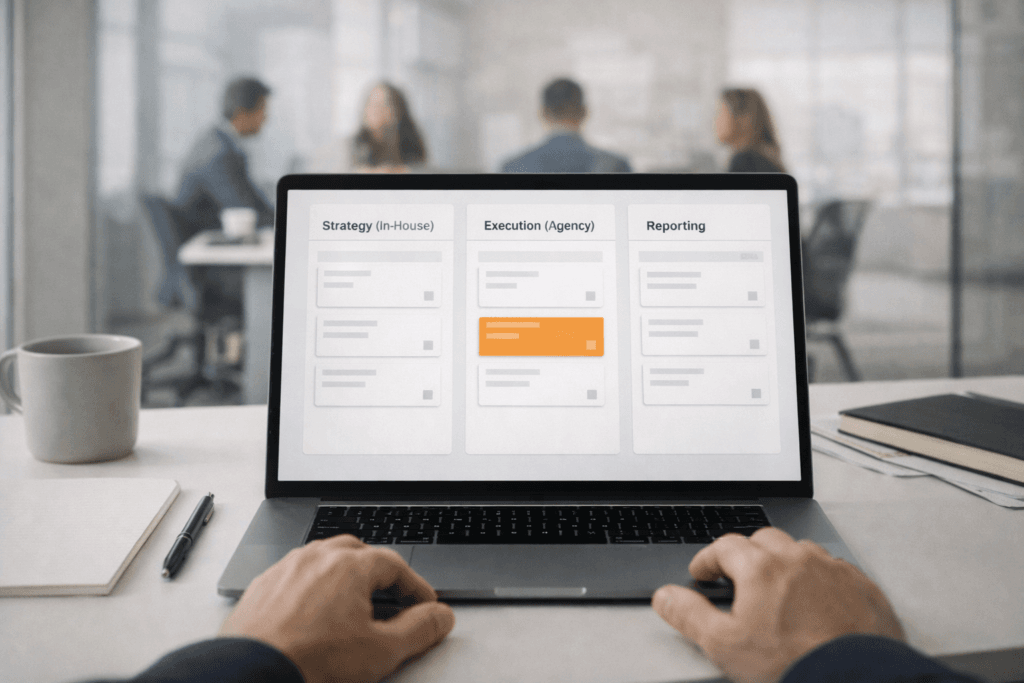
Here’s what most brands don’t realize: the agency vs. in-house decision isn’t binary. The highest-performing brands run a hybrid model—combining in-house strategic ownership with external specialist support.
This looks like:
- In-house: 1–2 people who own strategy, budget allocation, and performance reporting
- Agency/Consultant: Handles execution (campaign builds, bid management, search term mining, negative keyword management)
This model gives you the best of both worlds:
- You maintain strategic control and institutional knowledge
- You get consistent, high-quality execution without hiring a full team
- You can scale execution up or down based on seasonality and growth without hiring/firing
The catch? Most agencies don’t offer this. They want full control or nothing. So you need to find partners who are comfortable operating as an extension of your team, not as a replacement.
At $10M–$20M in revenue, this is often the most cost-effective model. You’re spending $40K–$60K/year on fractional support instead of $75K–$110K on full-time headcount, and you’re getting better execution because specialists are doing what they do best.
The Due Diligence Framework: How to Vet an Agency Without Getting Burned
If you decide to hire an agency, here’s the framework top brands use to avoid wasting 6 months and $30K–$100K on the wrong partner:
1. Ignore Case Studies, Ask for Account Audits
Every agency has case studies showing 200% revenue growth and 50% ACOS reduction. These mean nothing.
Instead, ask the agency to audit your account and present their findings. A good agency will:
- Identify specific structural issues (keyword cannibalization, budget misallocation, campaign hygiene problems)
- Explain exactly what they would change and why
- Set realistic expectations for timeline and results (not “we’ll double your revenue in 60 days”)
If they can’t do this, they’re selling process—not expertise. Walk away.
2. Demand Transparency on Reporting and Data Access
Ask these questions before signing:
- Will we have direct access to campaign structure, keyword data, and bid history?
- What reporting do we get, and how often? (Weekly? Monthly? Real-time dashboards?)
- If we part ways, do we keep all campaign data and documentation?
If the agency hedges on any of these, they’re planning to lock you in by making themselves irreplaceable. That’s not a partnership—it’s vendor dependence.
Non-negotiable: You should be able to fire the agency tomorrow and have everything you need to run PPC in-house or hand it to a new partner.
3. Understand Their Fee Structure and Incentive Alignment
Most agencies charge one of three ways:
- Percentage of ad spend: 10–15% of monthly ad spend. Problem: Agency is incentivized to increase spend, even if it’s not profitable for you.
- Flat monthly retainer: $5K–$20K/month regardless of spend. Better alignment, but expensive for smaller accounts.
- Performance-based: Base fee + bonus tied to profitability or TACOS improvement. Best alignment, but rare.
Ask: “If our ad spend decreases but our profitability improves, how does your fee structure handle that?”
If their revenue goes up when your profitability goes down, incentives aren’t aligned. Find a different model.
4. Test Communication and Responsiveness Before Signing
The single biggest complaint about agencies? Poor communication. You send a question on Monday, you get a response on Friday—maybe.
During the sales process, test this:
- Ask detailed questions and see how quickly they respond
- Request a call with the actual account manager (not just the sales team)
- Gauge their willingness to explain strategy vs. just promising results
If they’re slow or evasive during the sales process, it only gets worse after you sign. This is their best behavior—act accordingly.
The Decision Framework: Agency vs. In-House in One Table
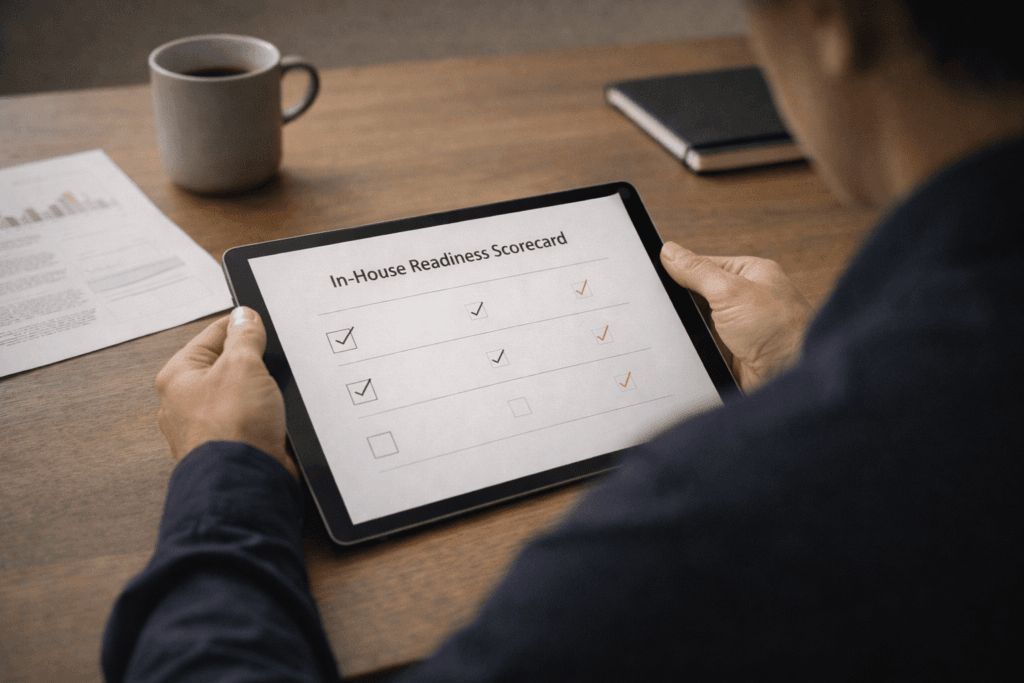
Here’s the simplified decision tree:
Choose IN-HOUSE if:
- You’re doing $10M+ in Amazon revenue with 12%+ net margin
- You can commit to a dedicated PPC role with 60%+ time on advertising
- You want full control over strategy and data
- You’re building long-term internal capability and don’t mind the 6–12 month ramp
Choose AGENCY if:
- You’re scaling 50–100%+ YoY and need infrastructure fast
- Your current PPC is broken and you don’t know how to fix it
- You’ve tried to hire in-house and can’t retain talent
- You’re doing less than $10M in revenue or operating below 12% margin
Choose HYBRID if:
- You’re doing $10M–$20M in revenue and want strategic control with execution support
- You have 1–2 people in-house who can own strategy but need help with execution
- You want flexibility to scale execution up/down seasonally without hiring/firing
The Bottom Line: Timing Matters More Than the Decision Itself
The worst outcome isn’t choosing agency over in-house, or in-house over agency. It’s making the decision at the wrong time.
Most brands hire an agency too early—when they don’t have enough scale to justify the cost—or too late—when they’ve already lost 6–12 months trying to do it in-house without the right infrastructure.
Here’s the framework:
- Under $5M in revenue: Stay in-house or use fractional support. Full-service agencies are too expensive relative to your margin.
- $5M–$10M in revenue: Agency makes sense if you’re scaling fast or your PPC is broken. In-house makes sense if you have margin and can hire dedicated talent.
- $10M–$20M in revenue: Hybrid model is ideal—in-house strategy with external execution support.
- $20M+ in revenue: Build in-house unless you’re expanding into new categories or markets where agency expertise adds value.
The other reality? This isn’t a forever decision. Most brands cycle through all three models as they scale:
- Start in-house (scrappy, learning mode)
- Hire an agency (scaling fast, need infrastructure)
- Move to hybrid (strategic control + execution support)
- Eventually bring everything in-house (long-term capability building)
The key is recognizing when you’re in the wrong model for your current stage—and making the switch before it costs you 6–12 months of momentum.
At AmzCentric, we work with brands at every stage of this journey—whether that’s full-service management, fractional support, or consulting to help you build in-house capability. If you’re trying to figure out which model makes sense for your business, we’d be happy to walk through the framework with you.
But whether you work with us or not, make sure you’re solving for the right problem: expertise or execution. Get that wrong, and no amount of agency fees or in-house hiring will fix it.
