
Writen by
Zain Zakir

Most brands treat Amazon PPC as a bidding war. They’re laser-focused on winning the buy box, beating competitors, and driving impressions. The problem? That mindset is costing them 30–40% of their advertising budget—sometimes more.
When you’re running $50K–$500K+ per month in Amazon ad spend, inefficiency isn’t just an operational issue. It’s a structural cap on growth. The brands scaling profitably past $10M aren’t spending more—they’re spending smarter. They’ve moved beyond reactive bidding and built advertising systems that protect margin while driving revenue.
This isn’t a beginner’s guide to Amazon PPC. If you’re reading this, you already know the basics. What you need is a framework for diagnosing where your ad spend is leaking and how to fix it without hiring an army of analysts or throwing more budget at the problem.
Let’s break down the three structural flaws that cause ad waste at scale—and what top-performing brands do differently.
The Real Problem: Most Brands Optimize for the Wrong Metrics
Here’s the reality: ACOS is a lagging indicator, not a strategic lever. Most brands obsess over ACOS targets (“we need to stay below 25%”) without understanding what’s driving the number in the first place.
ACOS tells you how much you spent relative to revenue generated from ads. That’s useful. But it doesn’t tell you:
- Which campaigns are actually profitable after accounting for COGS, fulfillment, and returns
- Whether you’re cannibalizing organic sales with branded search ads
- If your advertising is driving total account growth or just shifting revenue between channels
- How much of your ad spend is going toward keywords that will never convert at scale
At $10M+ in revenue, you can’t afford to optimize for ACOS alone. You need to understand
contribution margin by campaign, incrementality (did the ad create a sale or just capture one that was already happening?), and TACOS (Total Advertising Cost of Sales)—your total ad spend as a percentage of total revenue, not just ad-attributed revenue.

Why TACOS Matters More Than ACOS at Scale
ACOS can look great while your business quietly bleeds margin. Here’s how:
Let’s say you’re spending $100K/month on ads with a 25% ACOS. That means you’re generating $400K in ad-attributed revenue. Looks solid.
But what if your total revenue is $800K? That means your TACOS is 12.5%. You’re spending 12.5% of your total revenue on advertising. If your net margin is 15%, you’re left with 2.5% after ad spend—before accounting for returns, promotions, or any other operational costs.
Now imagine you scale ad spend to $150K/month. Your ACOS stays at 25%, so ad-attributed revenue grows to $600K. But if total revenue only grows to $900K (because some of that ad spend is cannibalizing organic sales or driving low-intent traffic), your TACOS jumps to 16.6%.
You just scaled yourself into unprofitability while your ACOS stayed “on target.”
This is the hidden trap most $10M+ brands fall into. They’re optimizing for the wrong outcome. TACOS forces you to evaluate advertising efficiency at the business level, not the campaign level. And that’s where the waste becomes visible.

Structural Flaw #1: Broad Match Campaigns That Never Get Killed
Broad match and auto campaigns are discovery tools. They’re designed to surface new keywords and test what converts. The problem? Most brands treat them like evergreen campaigns and never graduate winning keywords to exact match or negative out the junk.
Here’s what happens:
- You launch a broad match campaign to test new keywords
- Amazon starts matching you to hundreds of search terms—some relevant, most not
- A handful of keywords perform well, so you leave the campaign running
- Six months later, you’re still spending 30–50% of your budget on broad match, and 40% of those impressions are going to keywords that will never profitably convert
At $10M+ in revenue, this is where ad waste compounds. Every dollar spent on an irrelevant keyword isn’t just wasted—it’s a dollar you’re not spending on a proven keyword that could drive incremental revenue.
The Fix: Treat Broad Match as Temporary
Top-performing brands run a tight keyword lifecycle:
- Discovery phase (Weeks 1–4): Run broad match or auto campaigns to surface new keywords. Set conservative budgets and aggressive ACOS targets.
- Graduation phase (Week 5+): Any keyword that converts profitably 3+ times gets moved to an exact match campaign with higher budgets. Everything else gets negated.
- Ongoing pruning: Every 30 days, review search term reports and negative out anything that hasn’t converted in 60 days or has an ACOS above your profitability threshold.
This isn’t rocket science. But it requires discipline. Most brands don’t have the bandwidth to do this consistently, so they let broad match campaigns rot—burning 20–30% of their ad spend on keywords that will never drive profit.
If your broad match campaigns are older than 90 days and you haven’t negated anything in the last 30 days, you’re almost certainly wasting money.
Structural Flaw #2: Branded Search Cannibalization
Here’s a question most brands don’t ask: How much of your ad spend is going toward people who were already going to buy from you?
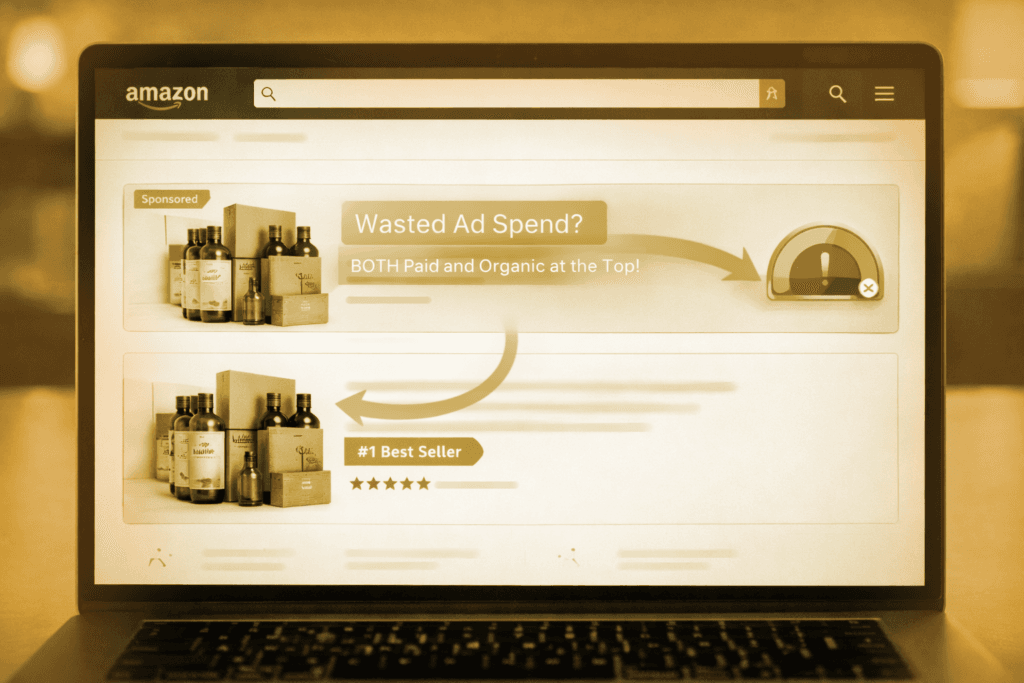
Branded search is the biggest offender. If you’re bidding on your own brand name, you’re paying for clicks from customers who were already searching for you. In most cases, you’d rank #1 organically anyway. So you’re paying Amazon for traffic you’d get for free.
At $10M+ in revenue, this is expensive. Branded search campaigns often account for 10–20% of total ad spend—and most of that spend is purely incremental cost with zero incremental revenue.
When Branded Search Makes Sense (and When It Doesn’t)
There are only three scenarios where branded search is worth the spend:
- Defensive bidding: A competitor is bidding on your brand name and ranking above you. In this case, you need to bid to protect your traffic. But monitor this closely—most competitors stop after a few weeks when they realize branded search doesn’t convert.
- New brand awareness: If you’re investing heavily in off-Amazon marketing (Meta, Google, TikTok), branded search can capture incremental traffic from people who heard about you elsewhere and are now searching on Amazon. But this only works if off-Amazon spend is driving net-new awareness, not just retargeting existing customers.
- Category dominance: You want to own 100% of the top 4 placements for your brand name—organic and paid—to prevent any competitor from appearing in the results. This is a brand-building play, not a revenue play. It’s expensive and only makes sense if you have the margin to justify it.
If none of these apply, you’re wasting money. Turn off branded search and redirect that budget to high-intent, non-branded keywords that actually drive incremental sales.
Run a simple test: Pause your branded search campaigns for 30 days and measure total revenue (ad-attributed + organic). In most cases, revenue stays flat or drops less than 5%—meaning you were paying for sales that would have happened anyway.
Structural Flaw #3: No Clear Profitability Threshold by Campaign Type
Most brands set one ACOS target—usually 20–30%—and apply it across all campaigns. This is a mistake. Not all campaigns serve the same purpose, and forcing them all into the same ACOS target either starves growth or bleeds margin.
Here’s the reality:
- Branded search campaigns should run at 10–15% ACOS (or lower). These are high-intent, high-conversion keywords. If your branded ACOS is above 20%, something is broken.
- Exact match campaigns on proven keywords should run at your target ACOS (usually 20–30%). These are your core revenue drivers.
- Broad match and auto campaigns should run at 40–50% ACOS (or higher) because they’re discovery tools, not profit centers. You’re willing to pay more to find new keywords, but only temporarily.
- Product launch campaigns should run at break-even or slight loss (50–80% ACOS) for the first 60–90 days to build velocity and ranking. After that, they need to hit target ACOS or get paused.
If you’re not segmenting campaigns by intent and setting different profitability thresholds, you’re either leaving growth on the table (by pausing discovery campaigns too early) or bleeding margin (by letting unprofitable campaigns run too long).
The Framework: Campaign-Level Profitability Rules
Top-performing brands run Amazon PPC with clear rules for every campaign type:
- Branded search: Target 10–15% ACOS. If ACOS exceeds 20% for 30 days, pause and evaluate if defensive bidding is necessary.
- Exact match (proven keywords): Target 20–30% ACOS. These campaigns get the largest budgets and should drive 50–60% of total ad revenue.
- Broad/auto discovery: Target 40–50% ACOS. Review every 30 days. Graduate winners to exact match and negative out losers. Budget cap at 20% of total ad spend.
- Product launch: Target 50–80% ACOS for first 60–90 days to build ranking. After 90 days, must hit 30% ACOS or campaign gets paused.
This kind of structure prevents the slow bleed of margin that happens when you let underperforming campaigns run indefinitely because “they’re still driving some sales.”
The Operational Reality: Why This Breaks Down at Scale
Most brands reading this know they have ad waste. The challenge isn’t awareness—it’s execution.
At $10M+ in revenue, you’re managing:
- 50–500+ campaigns across multiple SKUs
- Thousands of keywords with different performance profiles
- Constant changes to bids, budgets, and negatives
- Inventory fluctuations that impact campaign performance
You can’t do this manually anymore. The brands that scale profitably past $10M have one of two things in place:
- A dedicated PPC team with clear SOPs for keyword lifecycle management, bid optimization, and campaign structure. This usually means 1–2 full-time specialists just on PPC.
- An external PPC partner (agency or managed service) that brings infrastructure, tooling, and expertise you don’t have in-house.
Both options cost money. But they cost less than continuing to burn 30–40% of your ad spend on structural waste.
The worst option? Trying to manage PPC at scale with one overstretched e-commerce manager who’s also responsible for inventory, listings, promotions, and customer service. That’s how ad waste becomes permanent.
What Top-Performing Brands Do Differently
The brands that scale Amazon profitably don’t have magic. They have systems. Here’s what they do differently:
- They track TACOS, not just ACOS. They measure advertising efficiency at the business level and adjust spend based on total account profitability, not campaign-level metrics.
- They treat broad match as temporary. Discovery campaigns have a 90-day lifecycle. Winners graduate to exact match. Losers get negated. Nothing runs indefinitely.
- They audit branded search quarterly. They test pausing branded campaigns every 90 days to measure incrementality. If pausing branded search doesn’t hurt revenue, they reallocate that budget.
- They set different ACOS targets by campaign type. Branded search runs at 10–15%. Exact match at 20–30%. Discovery at 40–50%. Product launch at 50–80% for the first 90 days only.
- They review search term reports weekly. They don’t wait until a keyword has spent $1,000 before negating it. They catch waste early and redirect budget to proven keywords.
None of this is complicated. But it requires consistent execution—and that’s where most brands fail.
The Bottom Line: Ad Waste is a Systems Problem, Not a Tactics Problem
If you’re running $50K–$500K+/month in Amazon ad spend and you’re not tracking TACOS, auditing broad match campaigns monthly, or setting campaign-specific profitability thresholds, you’re almost certainly wasting 30–40% of your budget.
The good news? This isn’t a strategy problem. You don’t need a new playbook. You need operational discipline and the infrastructure to execute consistently.
Most brands at $10M+ hit this inflection point: PPC has become too complex to manage manually, but they’re not yet at the scale where hiring a full PPC team makes sense. That’s where the waste compounds.
The brands that scale profitably recognize this and either:
- Build the internal infrastructure (team, tooling, SOPs) to execute PPC at scale
- Partner with an external team that already has that infrastructure in place
Both options cost money. But both cost less than continuing to burn margin on structural ad waste.
If you want to dig deeper into how AmzCentric helps brands reduce ad waste and scale profitably, we’d be happy to talk. But whether you work with us or not, start with the fundamentals: track TACOS, kill broad match waste, audit branded search, and set campaign-specific profitability rules.
