
Writen by
Zain Zakir
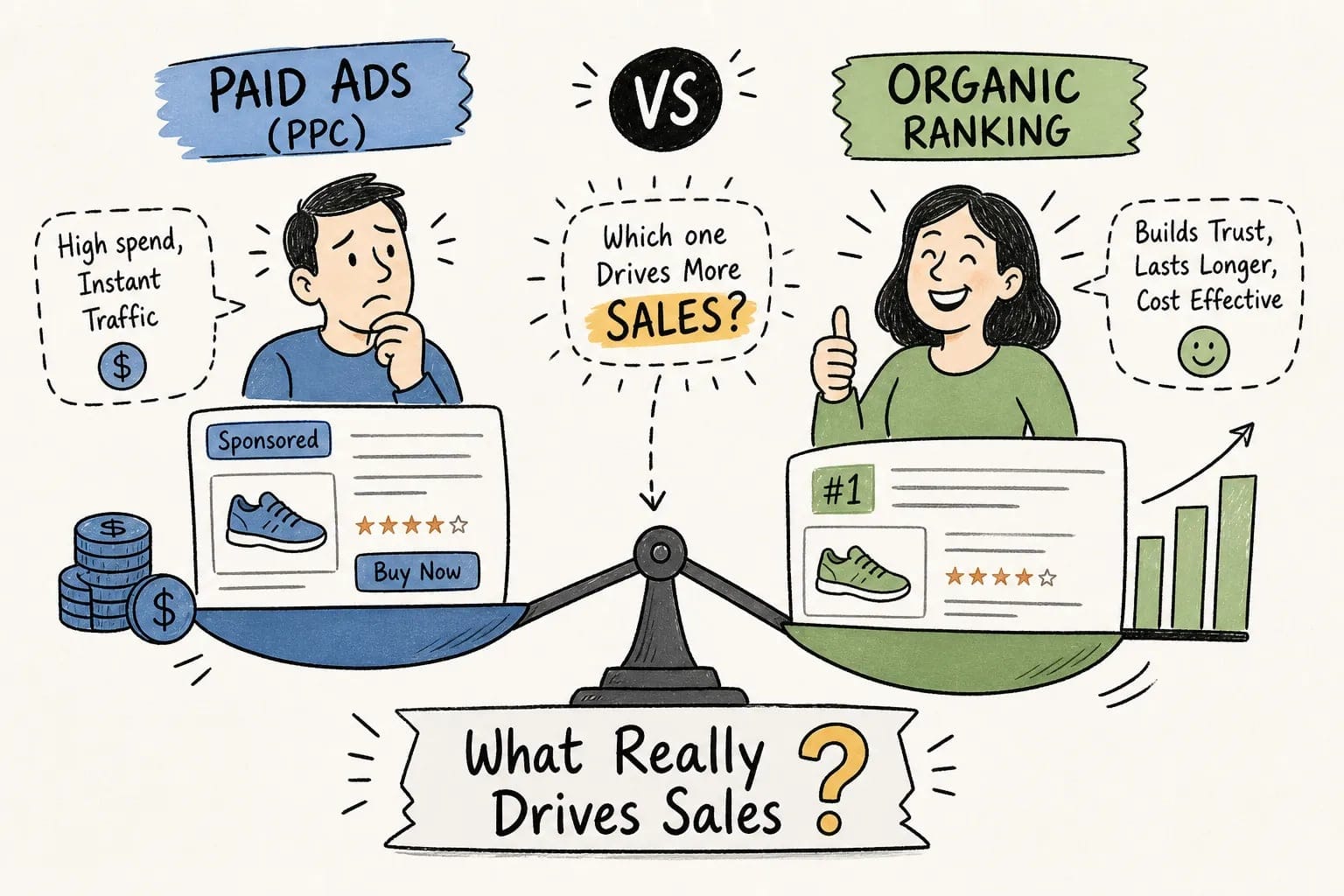
If you’ve ever wondered what is the difference between Amazon PPC and organic ranking, you’re asking the right question, and the answer goes much deeper than “paid versus free.” Running ads while watching organic rank sit flat is one of the most frustrating experiences in Amazon selling. You’re spending thousands every month, moving product through paid traffic, and your listing still doesn’t show up organically for the keywords that matter. Or the opposite: you’ve put real effort into your listing, the copy is tight, the images are solid, and you still can’t get traction without ads propping everything up.
These are two separate systems with different mechanics, different timelines, and a relationship that most sellers manage poorly because they don’t fully understand how each one works or how they interact. Most brands treat them as parallel channels and manage them separately. The ones that scale profitably, the kind AmzCentric works with regularly, treat them as one integrated system where every decision in one channel affects the other.
This article breaks down exactly how each system works, which metrics you should actually be tracking, and how to use both together to build visibility that compounds over time rather than disappearing the moment you pause a campaign.
How Amazon Organic Ranking Actually Works
The algorithm signals that control your visibility
Amazon’s ranking algorithm (referred to as A9 in earlier documentation and increasingly described by practitioners as A10 in its current form) decides which products appear and in what order for any given search query. Two pillars drive everything: relevance and performance. Relevance determines whether your listing is eligible to appear for a query. Performance determines how high it ranks among all eligible results.
The A10-style evolution shifts more weight toward organic performance signals and less toward PPC-driven activity than its predecessor. Conversion rate, organic sales velocity, seller account health, and external traffic that converts all carry more influence in 2026 than they did under the older framework. Understanding this matters because it changes how you should allocate your time and budget across both channels.
Why conversion rate and sales velocity are the real ranking currency
Amazon rewards listings that sell consistently. A high conversion rate tells the algorithm that shoppers find your listing compelling enough to buy, and sustained sales velocity tells Amazon there’s consistent, ongoing demand. These two signals together are the most direct path to holding and improving organic rank.
A listing with a 15% conversion rate and moderate traffic will generally outperform a listing with more clicks but an 8% conversion rate. The math is straightforward: more purchases per 100 visitors means a stronger performance signal to the algorithm. This is why listing quality, your copy, images, A+ content, and pricing (none of it is a one-time optimization task), feeds directly into rank. Conversion drives velocity, and velocity determines where you show up.
What “relevance” actually means for your listing
Amazon indexes the text in your title, bullet points, description, and backend search term fields to determine whether your product should appear for a given query. Title and bullet text carry the most indexing weight; backend fields matter but don’t override weak front-end content. Keyword placement in your title is still one of the highest-leverage listing decisions you can make.
Relevance isn’t just exact-match keyword presence. Amazon’s current algorithm reads intent and context, not just literal strings. A title written for shoppers that includes your primary terms naturally will outperform a keyword-stuffed title that reads like a parts list. Semantic relevance matters, which means listing optimization should start with understanding what your buyer is actually searching for, then writing content that matches that intent at every level of the page.
What Is the Difference Between Amazon PPC and Organic Ranking?
The three main ad types and where they appear
Sponsored Products promote individual ASINs and appear directly in search results and on product detail pages. They run on a CPC model and are the highest-intent ad format Amazon offers because they reach shoppers who are actively searching for a specific product type. Sponsored Brands show a header-style ad with your brand logo and multiple products, typically at the top of search results, also on CPC. They’re more effective for brand awareness and driving consideration across your product line.
Sponsored Display operates differently. It reaches shoppers using audience-based and product-based targeting, appearing across Amazon properties and sometimes on external sites. It’s available on both CPC and vCPM pricing depending on your objective. Each ad type creates visibility at a different stage of the shopping journey, which is why a mature PPC strategy uses all three rather than relying exclusively on Sponsored Products.
How the bid auction determines your placement
Every time a shopper searches a keyword you’re targeting, Amazon runs a real-time auction among all advertisers competing for that placement. The highest bid doesn’t automatically win. Amazon factors in your bid alongside ad relevance and the expected likelihood that a shopper will click and convert. A well-optimized listing with a competitive bid can beat a poorly optimized listing bidding higher, similar in spirit to how ad quality influences placement on other major platforms.
Your actual CPC is typically lower than your maximum bid, because Amazon charges you just enough to beat the next-best bidder, not the full amount you offered. Listing quality feeds directly into your auction competitiveness, which is another reason why organic SEO and paid advertising are more connected than most sellers realize.
Targeting options and what each one is best for
Sponsored Products support both automatic and manual targeting. Automatic campaigns let Amazon decide which search terms and products your ad is eligible for, based on your listing content. These are most useful for keyword discovery: finding terms you hadn’t considered that actually convert. Manual campaigns give you control over specific keywords or ASINs, with match types including broad, phrase, and exact.
Exact match on proven, high-converting terms is where your most efficient spend happens. For building keyword-attributed sales velocity, which is what drives organic rank improvement, tight targeting on your most important terms produces better results than spreading budget across a wide, loosely defined campaign structure. Auto campaigns discover. Manual campaigns execute.
Comparing Amazon PPC vs. Organic Ranking: Speed, Cost, and Sustainability
Speed and control: paid versus earned visibility
PPC delivers visibility fast. Campaigns go live within hours of approval, and traffic follows within days. Organic rank takes weeks to months, with most competitive terms requiring 60 to 90 days of sustained performance before meaningful upward movement appears. For new product launches, this timeline difference is critical to account for in your growth plan.
The trade-off is control versus compounding. PPC is fully controllable: you can turn it on, off, or scale it by adjusting your daily budget at any time. Organic rank, once earned, works continuously without a per-click cost attached to every sale. A page-one organic position for a high-volume keyword delivers traffic regardless of whether you’re actively managing campaigns that day.
Cost model: what you’re actually paying for in each channel
With PPC, you pay for every click, and your visibility stops the moment your budget runs out or a campaign is paused. With organic ranking, the cost is front-loaded into listing optimization, content quality, and the time and budget required to build initial sales velocity, which typically requires early PPC spend anyway. The two are rarely as separate in practice as they appear in theory.
Real 2026 benchmark numbers put the reality into focus. Median ACoS ranges from 23% in Food and Grocery to 57% in Clothing and Apparel. Median CPC runs from $0.40 in Books to $1.42 in Health and Household, with Beauty at $1.18 and Electronics at $1.11. These figures represent the actual cost of buying visibility through paid channels, which is why the math on an ads-only strategy gets difficult fast in competitive categories.
Sustainability: why only one channel creates fragility
A brand running on PPC alone is one budget cut away from losing all its visibility. There’s no organic floor to catch the drop when campaigns pause. A brand running on organic alone can’t compete effectively for high-volume terms where competitors are buying above-the-fold placement, and new product launches stall without the early sales velocity that paid traffic can provide.
The durable position is a brand with organic rank that has been built with PPC as the accelerant, not the permanent engine. That distinction is where most sellers need to shift their thinking before anything else changes.
The Metrics That Tell You How Each Channel Is Really Performing
What to track on the PPC side: ACoS, TACoS, CTR, and CPC
ACoS, calculated as ad spend divided by ad-attributed revenue, tells you how efficient a campaign is in isolation. It’s useful for evaluating individual campaigns against your margin targets, but it doesn’t tell you whether your ads are growing the business overall. TACoS does that. TACoS divides your total ad spend by your total revenue, including organic, and gives you a clear read on how dependent your business is on paid traffic. A declining TACoS over time is one of the healthiest signals a growing Amazon brand can show.
CTR diagnoses whether your ad is connecting with shoppers at the impression level. A low CTR on a keyword you know is relevant usually points to a problem with your main image, price point, review count, or how your listing appears compared to competitors. For category context: Beauty and Personal Care averages 0.54% CTR with $1.18 CPC and 31% ACoS, while Electronics runs 0.38% CTR at $1.11 CPC and 30% ACoS. Comparing your performance to your category baseline tells you whether you have a targeting problem, a listing problem, or a competitive positioning problem.
What to track on the organic side: search rank, sessions, and conversion rate
Organic performance is measured differently from paid. Track your keyword rank for primary terms on a weekly basis; movement here shows whether your listing is gaining or losing ground with the algorithm. Sessions from Seller Central tell you how much organic traffic your listing is actually pulling in, separate from paid clicks. Organic session data, compared week over week, shows whether your rankings are translating into real traffic volume.
Conversion rate on organic sessions is the most honest signal of listing quality. If shoppers are landing on your listing and not buying, the algorithm will notice and your rank will drift down over time regardless of how much you spend on ads. A strong organic conversion rate combined with growing organic sessions confirms that your listing is earning its position, rather than being held up by paid spend.
How PPC and Organic Ranking Influence Each Other
The flywheel: how paid traffic builds organic momentum
PPC doesn’t directly purchase organic rank. Amazon does not count ad spend as a direct ranking signal. But PPC can drive the outcomes that do influence organic rank: specifically, converting sales attributed to a target keyword. When a shopper clicks a Sponsored Products ad and buys the product, that sale registers as keyword-attributed revenue and contributes to the listing’s sales velocity for that term. Sustained, converting PPC on the right keywords creates exactly the velocity signal the algorithm uses to assign organic rank.
Here’s how the flywheel works in practice: PPC drives converting sales and builds keyword-attributed velocity. That velocity improves organic rank. Better rank reduces reliance on paid traffic. Reduced ad dependence improves margin. The brands that execute this well don’t just run ads, they use ads strategically, on tightly targeted terms, to build the organic foundation that eventually carries the business.
Why poor-converting campaigns work against you
The flip side is equally important. PPC campaigns that drive clicks without conversions don’t contribute meaningful velocity signals. High click-through with low conversion can signal a relevance mismatch, which affects both your ad quality performance and the overall metrics on your listing. Broad-match auto campaigns chasing irrelevant terms don’t produce the organic lift sellers expect from them, and they drain budget that could be working harder on proven terms.
Targeting precision matters as much as spend volume. Running $5,000 a month across loosely matched keywords will produce weaker organic lift than $2,000 concentrated on the 10 keywords most critical to your category. Campaign structure and keyword selection aren’t just PPC decisions, they’re organic ranking decisions too.
Why Relying on Just One Approach Creates Serious Risk
The problem with an ads-only strategy
Sellers running Amazon primarily on PPC face a structural margin problem. Every sale depends on paid traffic, which means TACoS stays elevated and profit margins compress as CPC increases with category competition. When campaigns pause, for cash flow reasons, a budget adjustment, or a seasonal shift, visibility collapses immediately. There’s no organic floor to absorb the drop.
These brands also tend to have listings that haven’t been optimized for conversion because the focus has always been on bidding, not on what happens after the click. That means they’re overpaying for every sale, because their listing isn’t closing the deal as efficiently as it could. The ads are doing work that a better listing would do for free.
The problem with an organic-only strategy
Pure organic plays can work in low-competition niches, but they break down fast in established categories. New product launches without any PPC support take too long to build the sales velocity needed to generate meaningful organic rank, and listings often stall at low-visibility positions for months. Without paid traffic to generate early reviews and ranking signals, even a well-optimized listing can sit on page five indefinitely.
Organic-only strategies also leave significant revenue on the table for high-intent keywords where competitors are buying above-the-fold placement and capturing the majority of clicks. Shoppers rarely scroll past the first page. If you’re not showing up there through paid or earned placement, you’re not part of the consideration set for most of your potential buyers.
A Practical Action Plan to Use Both Together
Step 1: Build a listing that converts before you spend on ads
PPC spend on a weak listing is money wasted. Before launching or scaling campaigns, get the fundamentals right: a keyword-rich title that reads naturally, benefit-focused bullets, high-quality images that stop a scroll, and A+ content if you’re brand registered. A+ content gives you additional real estate to address buying objections and show the product in context, both of which lift conversion.
Your conversion rate is the foundation everything else compounds on. A listing converting at 15% needs far less ad spend to hit the same sales velocity target as one converting at 8%. Getting that number up before you invest heavily in traffic is the highest-ROI work you can do, and it pays off in every channel simultaneously.
Step 2: Use PPC to build velocity on your most important keywords
Once your listing is ready, launch Sponsored Products campaigns in exact match on the 5 to 10 keywords most central to your category. The goal in the first 30 to 90 days isn’t necessarily campaign-level profitability. It’s building keyword-attributed sales velocity to signal relevance and rank potential to the algorithm. Track TACoS, not just ACoS, to measure whether the spend is lifting total revenue or just recirculating it through the ad attribution window.
As organic rank climbs for a keyword, reduce PPC bids on that term gradually and redirect the budget toward keywords where you still need velocity. Each dollar of early PPC investment earns its return not just through immediate attributed sales, but through the organic rank it helps build over the following weeks.
Step 3: Monitor rank movement and reduce ad dependence strategically
Track organic rank weekly on your primary keywords alongside TACoS. When a keyword moves to page one organically and your organic sessions increase, that’s the signal to reduce PPC spend on that term and redirect budget toward new keyword targets or a new product launch. A declining TACoS alongside stable or growing total revenue is the clearest indicator that your strategy is working.
The goal is a business where organic rank carries a growing share of your traffic, and PPC is the tool you use to stay competitive and expand into new terms, not the thing keeping your entire operation visible. That shift from ad-dependent to organically grounded is where real margin improvement happens.
Why Integrating Both Channels Compounds Results Over Time
The problem with siloed agency thinking
Most Amazon agencies manage either ads or listings, rarely both in a coordinated way. When the PPC team and the SEO team work separately, you get targeting decisions that undermine each other. Campaigns chase terms the listing isn’t optimized to convert on. Listing updates happen without reference to which keywords the ads need to rank. The result is higher ACoS, slower organic momentum, and a brand that stays permanently dependent on ad spend to maintain any visibility.
This isn’t a minor inefficiency. It’s a structural problem that keeps brands stuck on the paid traffic treadmill even when they’re spending significant money and working with experienced people on both sides. The channels are too interconnected to manage in isolation.
How a unified approach changes the math
The brands that scale most profitably on Amazon are the ones where paid and organic strategy are planned and executed as one system. AmzCentric’s Ad Care and Brand Care services are built around a single growth framework where keyword targeting, listing optimization, and bid strategy are aligned around the same conversion goals. The same keyword data that drives which search terms to rank organically also determines which terms to bid on and at what funnel stage.
That alignment creates compounding results rather than two separate channels working against each other’s budgets. For sellers who have been running ads and SEO separately, whether through different vendors or internal silos, unifying them is consistently where the biggest efficiency gains show up.
Putting It All Together
Understanding what is the difference between Amazon PPC and organic ranking is the starting point, but knowing how to use both together with intention is where compounding growth actually comes from. PPC gives you immediate visibility and the sales velocity to build organic rank. Organic rank gives you the cost-efficient, self-reinforcing traffic that makes your business defensible over time.
The gap between brands that grow profitably and those that stay stuck on the ad spend treadmill almost always comes down to whether they’re treating these as two separate problems or one integrated system. A high TACoS that never improves is a clear signal: your ads are keeping you visible, but your organic foundation isn’t being built. Closing that gap is where durable Amazon growth actually happens.
If you’re ready to move from running ads to building a system where paid and organic reinforce each other, reach out to the AmzCentric team. That’s exactly what we’re built to help you do.
