
Writen by
Zain Zakir
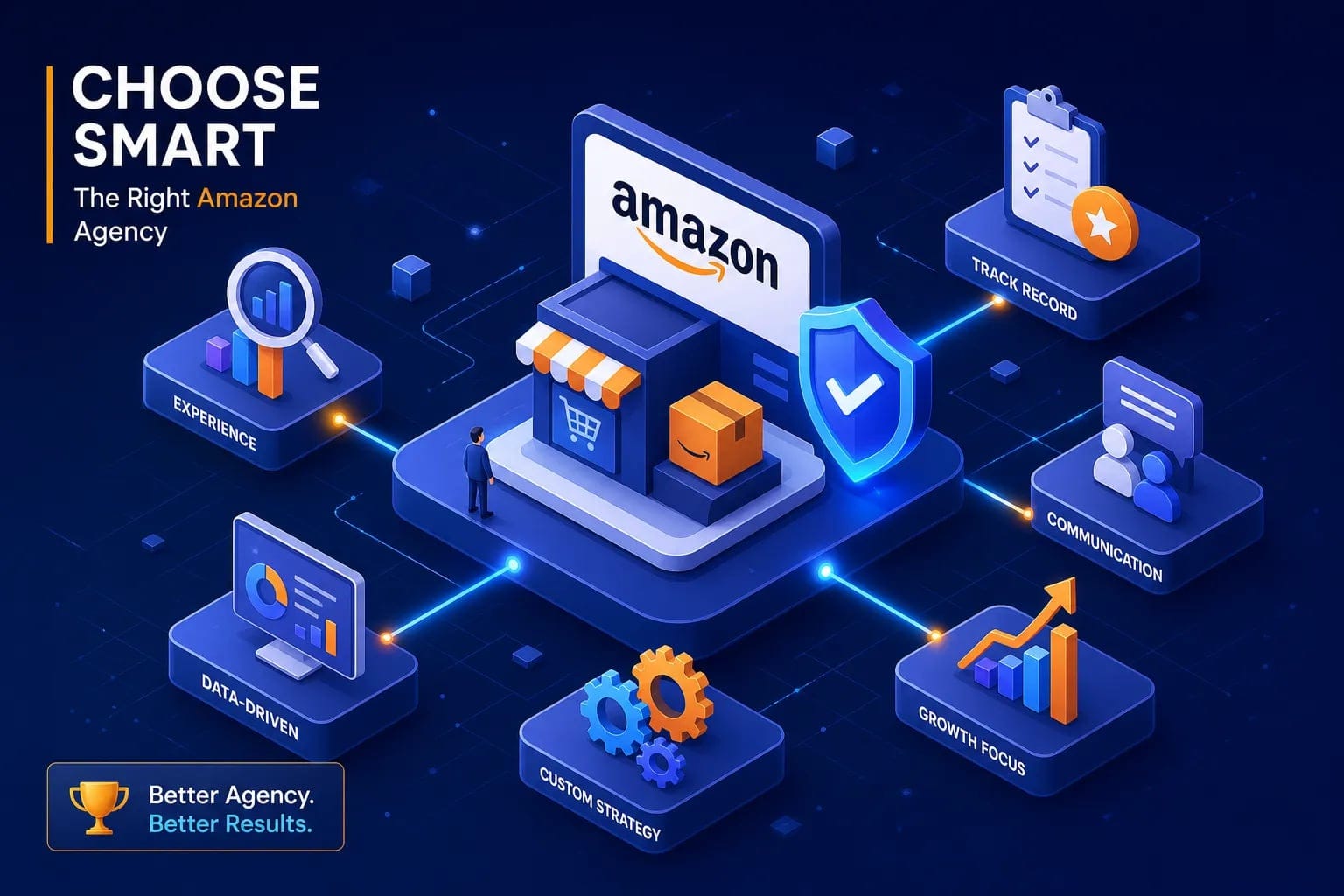
If you’re asking what you should look for in an Amazon agency for your brand, start with this: most agencies promise growth, a lower ACoS, and more sales. Many deliver neither. Knowing what to look for before you sign a contract is the only way to avoid wasting six months and significant budget finding out you hired the wrong partner.
This article gives you a practical Amazon agency checklist covering the 10 qualities that actually matter: unified strategy, account health, brand protection, category expertise, honest KPIs, fair pricing, and verifiable proof. Use what follows to evaluate any agency on your shortlist.
Why the agency market is so hard to navigate
Most agencies look identical on the surface. They all have case studies, a homepage full of logos, and a sales deck that uses words like “data-driven” and “full-funnel.” Cookie-cutter Bronze/Silver/Gold packages are common, and case studies rarely reflect category-specific experience. Differentiating on surface signals alone is almost impossible, so most brand owners default to price or pitch quality. Neither predicts results.
The explosion of Amazon agencies over the past several years has made this commoditization problem worse. Barriers to entry are low, some providers have limited experience despite presenting themselves as full-service partners. Without a structured evaluation framework, you are essentially guessing.
Why siloed strategy quietly kills brands
There is one failure mode that shows up more than any other: agencies that manage PPC separately from SEO and content. Ad campaigns bid on keywords the listing is not optimized for. Organic rank stagnates while ad spend climbs. TACoS creeps upward and nobody notices because ACoS looks fine in isolation. Brands rarely diagnose this until the damage is already done and margins have shrunk significantly.
A coherent strategy requires every element to work toward the same keyword and conversion goals. If the people running your ads and the people writing your listings are not in constant communication, or are not even on the same team, you are paying for two parallel efforts that often contradict each other. A structured evaluation framework is designed to prevent exactly that failure.
What should I look for in an Amazon agency for my brand: Unified SEO and PPC
This is not a nice-to-have. It is the foundation of everything else. An agency that runs ads and optimizes listings as separate workstreams is not a growth partner; it is two freelancers under one roof. Real integration means the same keyword strategy powers both listing copy and ad targeting simultaneously.
What a truly integrated growth system looks like
When a brand’s organic ranking improves on a target keyword, ad spend on that keyword should adjust accordingly. When conversion rate data shows that a keyword drives clicks but not purchases, that signal should feed back into both the listing and the campaign structure. That kind of coordination requires a single framework, not two siloed teams with separate reports.
A well-built agency ties its SEO and listing functions to its PPC functions around the same keyword and conversion objectives from day one. That alignment is what produces compounding results over time rather than short-term ad-dependent spikes that collapse when spend drops.
How to spot an agency that just says “integrated”
Ask directly: how do your SEO and PPC teams communicate, and how often? Then ask them to walk you through a specific example where an organic ranking goal changed how they structured a campaign, ideally a dated example where a ranking improvement triggered a bid adjustment. Vague answers reveal siloed operations dressed up in integration language.
If the answer is essentially “we have weekly team meetings,” push harder. The test is not how often they talk; it is whether their decisions in one channel visibly affect decisions in the other. Look for an activity log or integrated dashboard that shows cross-channel actions. That level of operational coherence is rare and worth paying for.
Criterion 3-4: Account health and brand protection are non-negotiable
Many PPC-focused agencies touch only the ad console, leaving the rest of your Amazon business unmanaged. Account health issues, suppressed listings, policy warnings, ASIN removals, these can wipe out months of ranking progress overnight. An agency that only manages your ads is not a full-service partner.
What full account management actually covers
A credible full-service agency should handle Seller Central operations, catalog troubleshooting, FBA coordination, and compliance monitoring. When a listing gets suppressed or a policy flag appears, the agency should be catching it and resolving it, often before you even know it happened. That operational coverage is what separates an agency from an ad management shop.
This matters most during launches, Q4, or any period where inventory and ranking pressure are highest. Operational blind spots get expensive fast in those windows. The agency you hire should have clear accountability for the account as a whole, not just the campaigns.
Brand protection as a core service, not an add-on
Unauthorized seller removal, Buy Box defense, IP protection, and hijacker monitoring should be part of the standard operating model, not an optional upgrade. A compromised listing undercuts everything else the agency is working on. It is pointless to drive traffic to a listing where a hijacker is capturing the Buy Box at a lower price with counterfeit product.
Ask any prospective agency a simple question: “Who handles a hijacker situation, and what is your response process?” A well-built agency has a documented escalation path. An agency that pauses before answering has probably never thought about it seriously.
Criterion 5: Category experience matters more than agency size
A large generalist agency managing hundreds of brands across every category is not necessarily a stronger partner than a focused agency that has spent five years in your specific space. Size signals resources. Category depth signals understanding. The latter is more valuable for your results.
Why category knowledge is a strategic asset
An agency that manages beauty brands builds real intuition about ingredient claim compliance, image sequencing for conversion, and repeat-purchase ad structures. The same applies to supplements, pet products, home goods, and any other competitive niche. That accumulated experience shortens the learning curve, produces more realistic performance forecasts, and helps you avoid expensive mistakes that a generalist agency would need months of trial and error to learn.
Category expertise also means the agency has seen your competitors’ strategies before. They know which seasonal patterns affect demand, what typical conversion benchmarks look like at the detail page level, and where the common compliance pitfalls are. That institutional knowledge has real dollar value.
How to test for it in a sales conversation
Ask for two or three case studies from the same or adjacent category. Ask what a typical TACoS looks like at month three versus month twelve for a brand in your space. Ask about the biggest category-specific challenges they have navigated and how they resolved them.
Generic answers (“we work across all categories”) are a warning sign. Specific answers with numbers, named challenges, and concrete decisions are a green light. An agency that knows your category can speak fluently about your problems without you having to explain them first.
Criterion 6-7: KPIs and reporting that reflect the real business
Vanity metrics are the fastest way agencies hide poor performance. Click-through rates look fine even when conversion is broken. ACoS can improve while total sales decline. If you do not know which numbers actually matter, you can receive a polished report every month and not realize you are losing ground.
The metrics worth tracking and their realistic ranges
The core KPI set is ACoS, TACoS, ROAS, organic rank, and total revenue growth. TACoS is the most important high-level indicator because it shows ad spend as a percentage of total revenue, not just ad-attributed sales. A falling ACoS alongside flat or declining total sales usually signals underinvestment in growth, not efficiency.
For established products in moderately competitive categories, realistic 2026 benchmarks look like this: TACoS in the 8, 15% range (with 12% as a practical midpoint target), ACoS between 12, 30% depending on margin structure and campaign objective, and ROAS in the 4, 7x range depending on category and goals. Organic rank should show steady improvement over time, particularly for priority keywords in the top 20 results.
Red flags in how agencies report results
Watch for reports with no baseline metrics. If you cannot see where you started, you cannot measure progress honestly. Be equally wary of dashboards that surface clicks and impressions without conversion rates, or any report that makes ROAS the headline without showing profitability or margin context. Reporting that focuses only on ad-attributed revenue while ignoring total sales trends is a sign of selective storytelling, not transparency.
A trustworthy agency reports rankings, conversion rates, ad efficiency, and profitability in one coherent view. The goal of reporting is to drive decisions, not to look impressive. If a dashboard leaves you with no clear action, it is not doing its job.
Criterion 8-9: Amazon agency pricing models and what fair looks like in 2026
Pricing structures are not inherently good or bad, what matters is whether the structure aligns the agency’s incentives with your goals. Some models create conflicts you should understand clearly before you sign. Here are the four standard structures and when each tends to make sense:
- Percentage of ad spend (typically 10, 20%): common among PPC-focused shops; creates an incentive to increase spend regardless of profitability
- Monthly retainer ($1,500, $25,000+ depending on scope and brand size): the most common structure for full-service agencies; aligns fees with deliverables rather than spend volume
- Performance fee or revenue share (roughly 2, 10% of revenue, often paired with a smaller base retainer): ties agency earnings to growth, though scope definitions matter enormously here
- Project-based fees ($500, $5,000+ for audits or one-time engagements): appropriate for discrete work, not ongoing management
For mid-market brands, full-service retainers generally fall in the $3,000, $10,000 per month range when SEO, PPC, content, and account management are all included, though scope and brand complexity drive significant variation in that figure. Full-service agencies managing all four capability layers most commonly use a retainer or hybrid model. PPC-only shops lean toward percentage of ad spend or a smaller flat fee.
Pricing red flags that signal misaligned incentives
An agency paid purely on percentage of ad spend has a financial incentive to increase your spend, not reduce it. More spend means more revenue for them, regardless of whether that spend is profitable for you. That conflict is baked into the model and worth understanding before you agree to it.
Beyond the fee structure itself, watch for these contract red flags: no clear scope definition, fees that scale automatically with spend without a cap, vague deliverables, and minimum contract terms beyond six months without an exit clause. A confident agency does not need to lock you in for a year to prove their value. If a contract makes it difficult to leave when performance is poor, that is telling you something important about how the agency expects things to go.
Criterion 10: The proof to request before you commit
Case studies are marketing materials. They show what the agency wants you to see. What you need is proof that is specific, attributable, and independently checkable. There is a meaningful difference between the two.
What credible case studies actually contain
A strong case study names the client (or provides a verifiable reference), states the starting conditions clearly, describes the specific intervention, and shows results with a baseline, a defined timeframe, and an explicit measurement method. “Grew sales by 40%” means nothing without knowing the starting revenue, the time period, and whether that growth came from paid traffic or organic improvement. Vague results claims are not proof; they are marketing copy.
Request two or three examples from brands similar to yours in category and revenue size. If the agency cannot produce examples that match your situation, that is useful information in itself. Generic case studies from unrelated industries tell you nothing about how they will perform in your specific competitive environment.
How to verify before-and-after metrics independently
Ask to see sample reporting dashboards from an active client, with appropriate permission. Ask for a named reference client you can contact directly, ideally one in a similar category or revenue range. Confirm that quoted metrics are tied to total revenue trends, not just ad-attributed revenue in isolation.
If an agency hesitates to provide references or deflects verification requests, treat that as a hard stop. Transparency should be a default operating principle, not something you have to negotiate for. The agencies doing the best work are usually the most willing to let their results speak for themselves.
The questions that reveal an agency’s real approach
The evaluation conversation is the most valuable diagnostic tool you have. The questions below are not gotcha traps. They are designed to surface how an agency actually thinks and operates, not just what they say in their pitch deck.
Questions that test strategy depth
- “How do your SEO and PPC teams coordinate on keyword strategy, and how does a ranking goal change your campaign structure?”
- “Walk me through how you handled a suppressed listing or account warning for a client. What was the process and how long did it take?”
- “What does your onboarding process look like in the first 30 and 60 days, and what do you need from us to get started?”
- “What does TACoS typically look like at month three versus month nine for brands in our category?”
Agencies that can answer these questions specifically, with process detail and real numbers, have actually done the work. Agencies that respond with polished generalities are telling you something important about how they operate.
Questions that reveal accountability and communication
- “What does your reporting cadence look like, and who do we actually talk to week to week?”
- “How do you handle it when a campaign is not performing? What is the diagnosis and escalation process?”
- “Can you share a case study where results took longer than expected and explain what happened?”
- “What KPIs will you hold yourself accountable to in the first 90 days?”
The difference between a good and a great agency often shows up in how they answer the last two. An agency that deflects accountability questions or pivots immediately to results-only language is signaling how they behave when things get difficult. Great agencies have a clear answer because they have been in that situation and built a process around it.
Choosing the right agency comes down to a few clear things
Knowing what you should look for in an Amazon agency for your brand is ultimately about knowing what good looks like before you walk into the conversation. The checklist above covers the qualities that matter most: unified SEO and PPC, full account management, brand protection, category expertise, honest KPI reporting, fair and transparent pricing, and verifiable proof of results. Ask the questions above, push for specific answers, and request references you can actually contact.
AmzCentric is built around these principles. Their integrated growth system ties organic rankings, paid traffic, and conversion optimization into one coordinated strategy, with transparent reporting and full-service account oversight that covers the operational layer many agencies ignore. If you are evaluating agencies for your brand and want to see what that model looks like in practice, reach out to the AmzCentric team directly.
Use this framework on every agency you consider. The one that holds up under that scrutiny is the one worth hiring.
