
Writen by
Zain Zakir
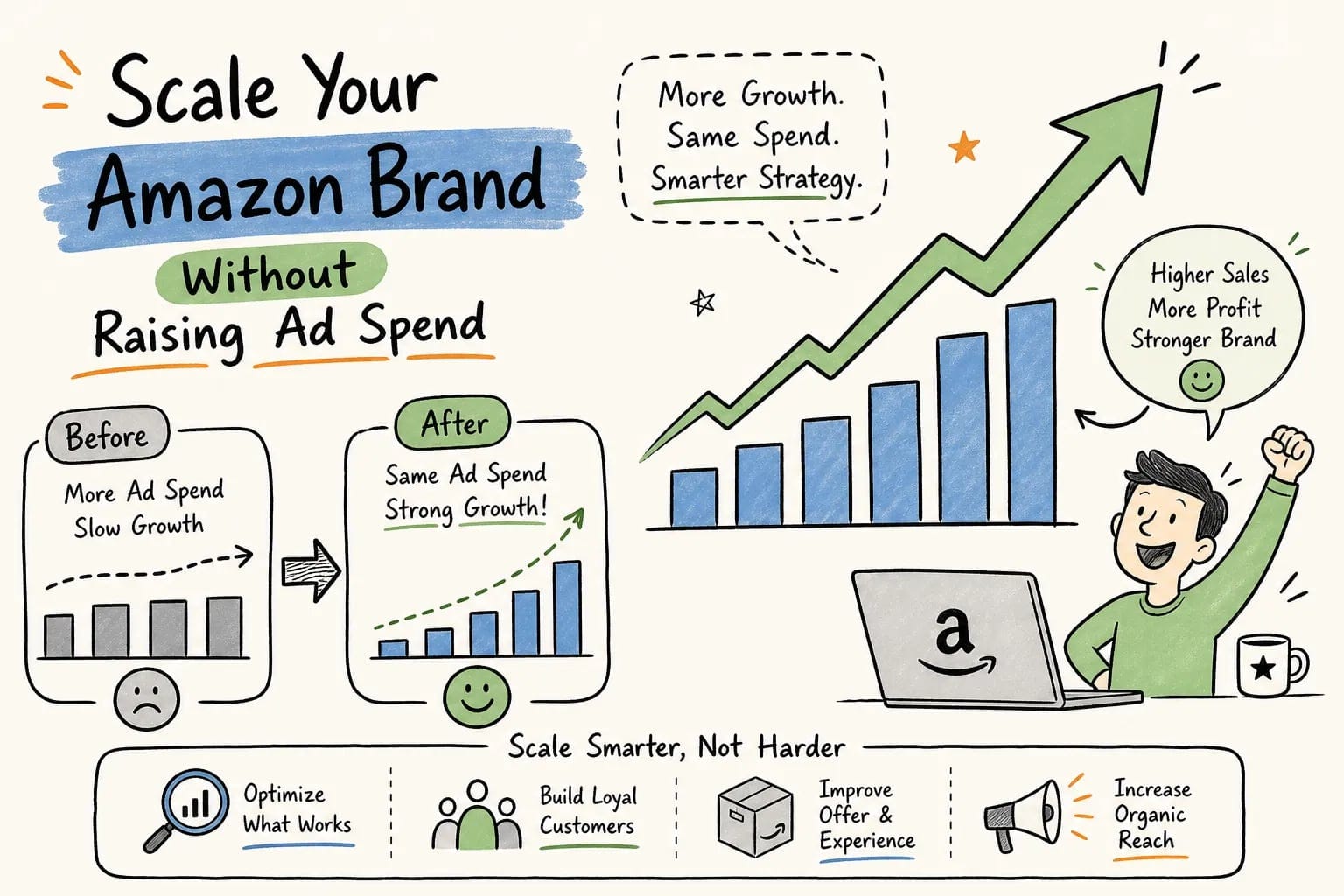
If you’re asking how to scale your Amazon brand without increasing ad spend too much, you’ve already identified the core tension every established seller faces. Revenue has plateaued, the category is getting more competitive, and the only lever that seems to move the needle is more budget. So you increase spend. Sales tick up for a few weeks. Then CPCs creep higher, ACoS follows, and you’re back where you started, except now your margins are thinner. This is the ad dependency trap, and it’s a common reason 6-figure Amazon brands stop growing profitably.
The metric that exposes the real problem isn’t ACoS. It’s TACoS: total ad cost of sale, which divides your total ad spend by your total revenue, not just ad-attributed revenue. When TACoS stays flat or rises as you grow, your business is becoming more reliant on paid traffic, not less. You’re running to stay in place. The alternative is an organic-first growth model, where listing conversion rate, keyword rankings, review velocity, and smarter PPC all work together to build momentum that compounds over time.
This is the framework that drives everything at AmzCentric. Not an ads-first approach that creates short-term spikes and long-term dependency, but a unified system where SEO, PPC, and conversion rate optimization reinforce each other so ad dependency decreases as the brand grows. The rest of this article unpacks that system in the order you should actually apply it.
Why scaling on ads alone is a losing strategy
ACoS and TACoS measure fundamentally different things, and confusing them is one of the most expensive mistakes growing Amazon brands make. ACoS reflects only ad-attributed revenue. TACoS captures what percentage of your entire business is propped up by paid traffic. Launch-stage brands typically carry ACoS of 30 to 60 percent, which is acceptable when the goal is rank and review velocity rather than immediate margin. Growth-stage brands should target 20 to 35 percent ACoS alongside TACoS in the 10 to 20 percent range. Mature, efficient brands should see TACoS compress to 5 to 12 percent as organic sales do more of the heavy lifting.
When revenue grows faster than ad spend, TACoS falls naturally. That’s the signal your organic foundation is working. When TACoS stays flat even as you scale budget, the brand is becoming more dependent on paid traffic rather than building toward independence from it. This distinction separates brands that compound over time from brands that hit a ceiling every time CPCs increase.
Many industry observers note that CPC inflation in competitive Amazon categories has risen year over year as more sellers bid for the same high-intent placements. There’s no purely budget-based solution to that problem. The only durable exit is to build the organic rank, conversion rate, and brand authority that reduce how hard your ads have to work in the first place. The results support this approach: Boxie grew Amazon Canada revenue by 55.4 percent on just 0.5 percent more ad spend through strategic listing cleanup and variation strategy. A pet supplements brand grew organic sales from $58,000 to $166,000 per month on flat ad spend after rebuilding its listings around modern search behavior. Across brands that have applied this system, the pattern is consistent: listing quality, PPC restructuring, and indexing discipline drive the gains, not budget increases.
How to scale your Amazon brand without increasing ad spend: catalog prioritization first
Before you touch a single listing or restructure a single campaign, you need to know which SKUs deserve your effort. Most brands spread optimization work across their entire catalog and see mediocre results everywhere. The right starting point is identifying the 20 percent of SKUs that drive 80 percent of your revenue potential, then narrowing further to the keywords within those SKUs that are within striking distance of page one. The criteria to evaluate: current organic rank, conversion rate relative to category benchmarks, review count versus top competitors, and contribution margin after fees and ad spend.
A practical SKU segmentation puts your catalog into four buckets. Stars have high margin and strong velocity; these get aggressive optimization across listings, creative, and PPC. Cash cows have strong margin but moderate velocity; protect their rank and refine conversion efficiency. Question marks have traffic but poor economics; fix the unit economics before investing in optimization. Dogs have low margin and low velocity; reduce, consolidate, or remove them entirely. This prioritization framework is the multiplier that makes every tactic below actually move the revenue needle.
Not every keyword within your hero SKUs is worth ranking for organically either. Some keywords are better served by efficient Sponsored Products campaigns with no ambition for organic rank. Others represent genuine opportunities to own a page-one position that reduces what you need to spend on ads over time. Categorize your target keywords by competitive difficulty, current organic rank position, and the realistic gap to page one. Brands that do this analysis first stop wasting conversion optimization effort on unwinnable battles and start concentrating firepower where it compounds.
Listing optimization: your highest-ROI conversion lever
A listing that converts at 5 percent when your category average is 12 to 15 percent is throwing away the traffic your ads already bought. This is one of the most common and most expensive inefficiencies on Amazon, and fixing it costs less than increasing your ad budget.
A+ content and full listing refresh
A+ content typically produces a 3 to 10 percent conversion rate lift on its own, with Premium A+ reaching 15 to 20 percent in some categories. A full listing refresh, title, bullets, A+ content, and backend keywords updated together, has produced a median 4.2 percentage-point CVR lift over 90 days across brands that have executed it properly. That kind of lift, applied to a high-volume SKU, often delivers more revenue than the same dollars spent on additional ad budget.
Category CVR benchmarks
Category benchmarks give you a realistic target to work toward. Supplements and grocery often convert at 15 to 25 percent on strong listings. Beauty clusters around 12 to 20 percent. Home and Kitchen typically falls between 8 and 18 percent. Electronics converts at 4 to 15 percent because of longer consideration cycles and comparison shopping behavior. If your CVR is below 5 to 8 percent in a category where 12 percent is standard, the constraint is your listing, not your traffic volume. That’s where optimization dollars should go before ad dollars.
Title, bullets, and backend keywords
Listing copy serves two masters simultaneously: the algorithm and the shopper. Keyword-rich titles that are also readable convert better and index better. Bullets should address purchase objections and reinforce confidence, not just stuff keywords into sentence fragments. Backend fields, alternate keywords, and subject matter terms expand your indexing surface area without cluttering the front-end copy. This is where CRO and SEO overlap directly. Treating them as separate disciplines, assigning listing copy to one team and keyword strategy to another, is a structural mistake most sellers make and pay for in wasted ad spend.
Building organic rank velocity without a bigger ad budget
Reviews remain one of the strongest ranking signals on Amazon, and neglecting review velocity is one of the fastest ways to create permanent ad dependency. The legitimate levers in 2026 are Vine for launch acceleration, the Request a Review button as your ongoing baseline, and compliant post-purchase sequences through brand-approved tools. Enroll strong SKUs in Vine early, in phased batches over the first 60 days rather than front-loading all units at once. The Request a Review button should run consistently on every eligible order from day one of sales.
The compounding effect is real: more reviews improve CVR, which improves BSR, which improves organic rank, which reduces the CPC you need to maintain visibility. Brands that skip review-building end up paying for that visibility with ads indefinitely.
Amazon’s algorithm rewards specific behavioral signals, click-through rate, add-to-cart rate, conversion rate, and sales velocity on individual keywords. When a listing consistently converts on a keyword, Amazon surfaces it higher organically for that term. Every conversion optimization improvement feeds directly into organic rank improvement. The flywheel is real: better listings convert more, organic rank rises, organic sessions increase, ad dependency decreases, and margin improves. The system is self-reinforcing when built correctly.
One of the quickest wins available to most brands is an indexing audit. Many sellers discover they’ve been running Sponsored Products campaigns on keywords their listing isn’t actually indexed for, which means they’re paying for clicks with zero organic upside. Regular indexing checks, backend term audits, and organic rank monitoring by keyword reveal where these gaps exist and which ones represent the highest-value fixes. Some of these are 15-minute corrections that immediately stop budget waste.
Restructuring PPC for efficiency, not volume
TACoS, not ACoS, should be your campaign management north star when the goal is profitable growth. ACoS only tells you how efficient your paid traffic is. TACoS tells you what proportion of your entire business depends on ads. A brand in growth mode should target 10 to 20 percent TACoS while organics build; a mature brand should push toward 5 to 12 percent. When organic sales grow, TACoS falls even if ad spend stays flat. This is the compounding effect you should be engineering deliberately, not just hoping for as a byproduct of more budget.
Brands that grew revenue without proportionally growing ad spend consistently followed the same restructuring pattern: rebuilt campaign architecture, strict search term controls, eliminated wasteful match types and placements, and reallocated budget toward proven performers. One seasonal outdoor gear brand grew revenue 68 percent while cutting ACoS in half using exactly this approach. The tactical specifics: aggressive negative keyword harvesting, single-keyword ad groups for top-priority terms, portfolio-level budget controls, and bid automation anchored to a target ACoS set by product margin rather than category average.
Sponsored Brands and Sponsored Display serve different purposes in an efficient structure. Sponsored Brands work best as a brand authority and cross-sell channel, routing shoppers to an Amazon Store or curated landing page where bundles and complementary products are presented together. This is an average order value strategy, not just a ranking tool. Sponsored Display, used for retargeting, recaptures shoppers who viewed but didn’t purchase, an efficient use of budget that doesn’t require finding entirely new traffic. Using these formats only as ranking drivers leaves most of their value on the table.
Scale Amazon brand without raising ad spend: using external traffic as an organic amplifier
External traffic quality determines its impact on organic rank. Google search captures shoppers with high purchase intent. Email converts efficiently from warmed audiences who already know your brand. Creator and influencer content drives discovery-to-purchase flow with social proof built in. Facebook and Instagram ads scale with strong creative and retargeting. Sending qualified external traffic directly to the Amazon product detail page, rather than through an intermediate landing page, produces a stronger ranking signal when the shopper is already close to a purchase decision. Cold audiences who need pre-qualification are the exception to this rule.
Without measurement, external traffic is guesswork. Amazon Attribution assigns tracking tags to each external campaign, channel, audience, and creative so you can see detail page views, add-to-cart events, and purchases by source. Adoption of this tool remains low relative to the number of brands running external campaigns. Brands that run Google, influencer, and email campaigns simultaneously without Attribution can’t identify which source is moving sessions, units, and organic rank. The result is budget spent without a learning curve, which means the same inefficiencies repeat each cycle.
Set realistic expectations on timeline. Organic rank changes from external traffic typically become visible over a 4 to 8 week window, not overnight. Test one channel, measure it with Attribution, then scale what’s working before layering in the next source. That discipline in testing sequence is what separates brands that build lasting external traffic programs from those that spend the budget and see nothing measurable.
AOV and merchandising tactics that grow revenue per visitor
Bundles are the single most reliable lever for increasing average order value on Amazon. By grouping complementary products into one purchase event, they raise units per order without requiring additional traffic to your listings. Identifying bundle candidates starts with purchase correlation data: products frequently bought together, complementary items where one enhances the use of the other, or consumables where a starter-plus-refill structure makes logical sense. Virtual bundles through Brand Registry are accessible without changing physical inventory or creating new ASINs, making them a low-friction starting point for most brands already enrolled.
Multi-buy promotions are particularly effective for consumables and repeat-purchase categories because they incentivize a larger single order from shoppers who were going to buy anyway. A tiered discount structure, “Buy 2, Save 10%,” for example, shifts the purchase decision from whether to buy toward how much to buy. Coupons work differently: they’re stronger for conversion than for basket expansion unless structured to reward a minimum spend threshold. One effective combination routes Sponsored Brands traffic to a Store or curated landing page featuring bundles or multi-buy offers, so paid traffic encounters a merchandising environment designed to grow order value rather than confirm a single-item purchase.
Brand authority as long-term ad cost insurance
Brand authority on Amazon does two things simultaneously: it increases the conversion rate of shoppers who land on your listings, and it reduces the CPC you need to pay to maintain visibility because your organic rank does more of the work. Premium A+ content, a well-designed Amazon Store, and consistent brand visual identity across listings all contribute to conversion rate and repeat purchase behavior. Brands with strong authority spend less defending their position because shoppers seek them out rather than stumbling onto them through broad-match ads.
Building organic rank and brand authority also creates a moat against competitive threats. Listing hijackers, counterfeit sellers, and review manipulation by competitors are real and common problems in competitive categories. Brand Registry, Transparency, and Project Zero address these threats systematically. Protecting the organic asset you’ve built is significantly cheaper than perpetually buying visibility through defensive ad campaigns when your BSR is under attack.
All eight areas covered in this article connect into a single compounding growth model. Better listings convert more. Higher CVR builds organic rank. Better organic rank drives free sessions. More sessions and reviews build brand authority. Brand authority reduces price competition pressure and decreases reliance on broad-match ad coverage. This is the approach the AmzCentric team has operationalized for clients across competitive categories: SEO, PPC, and CRO unified so that each element reduces the work the others have to do, and the whole system gets more efficient as it grows.
Start building the flywheel, not just running the ads
Scaling your Amazon brand without raising ad spend isn’t about cutting PPC. It’s about building the organic foundation that makes your PPC more efficient over time. The sequence matters:
- Start with catalog prioritization to focus effort on the SKUs and keywords where optimization compounds fastest.
- Fix conversion rate before adding more traffic, every click your ads buy deserves a listing that can close it.
- Build organic rank through listing quality, review velocity, and indexing discipline.
- Restructure PPC around TACoS targets tied to your margin stage, not just ACoS.
- Use external traffic strategically and measure every channel with Attribution before scaling it.
- Grow average order value through bundles and merchandising that turn existing traffic into larger baskets.
- Protect the brand authority you’ve built so competitors can’t erode it with defensive spend.
These aren’t isolated tactics you apply once and forget. They’re a unified system where each improvement feeds the next one. Brands that apply them in sequence stop running to stay in place and start seeing compounding growth instead.
The AmzCentric team applies this exact system for brands serious about profitable Amazon growth. If you want to learn how to scale your Amazon brand without increasing ad spend too much, start the conversation with our team today.
Frequently asked questions
How do I scale my Amazon brand without increasing ad spend too much?
Focus on the organic levers that reduce how hard your ads have to work: listing conversion rate, keyword indexing, review velocity, and TACoS-focused PPC restructuring. When organic sales grow faster than your ad budget, TACoS falls and margins improve. The seven-step sequence above is the practical starting point.
What’s the difference between ACoS and TACoS, and which should I track?
ACoS measures the efficiency of your paid traffic only. TACoS divides your total ad spend by your total revenue, so it reveals how dependent your entire business is on ads. TACoS is the more important metric for brands focused on building organic scale, because a falling TACoS signals that organic sales are doing more of the work over time.
How long does it take to see organic rank improvements from listing optimization?
A full listing refresh, title, bullets, A+ content, and backend keywords updated together, typically produces measurable CVR improvements within 30 to 60 days. Organic rank changes that follow from improved conversion signals usually become visible over a 60 to 90 day window. External traffic campaigns affecting organic rank often show movement in 4 to 8 weeks.
Is it possible to grow Amazon revenue while keeping ad spend flat?
Yes, and the case studies above illustrate it directly. Boxie grew Amazon Canada revenue 55.4 percent on 0.5 percent more ad spend. A pet supplements brand tripled organic monthly sales on flat ad spend. Both achieved this through listing optimization, campaign restructuring, and organic rank building, not budget increases.
What role does external traffic play in scaling without raising ad spend?
Qualified external traffic, from Google, email, or creator campaigns, sends a ranking signal to Amazon’s algorithm when it converts on the detail page. This can accelerate organic rank improvement without requiring additional Amazon PPC budget. Use Amazon Attribution to measure every channel before scaling, and expect to see meaningful rank movement over a 4 to 8 week window after launch.
