Writen by
Zain Zakir

Most brands still optimize Amazon listings like it’s 2019. They stuff keywords into titles, cram bullet points with search terms, and measure success by how many times they can repeat their primary keyword without triggering a suppression.
The problem? Amazon’s A9 algorithm has fundamentally changed. Keyword density—the number of times a keyword appears in your listing—no longer drives rankings the way it used to. In fact, over-optimization can actually hurt your performance by degrading conversion rate and suppressing your listings in the algorithm.
At $10M+ in revenue, outdated SEO tactics don’t just fail—they actively cap your growth. You’re competing against brands that understand how Amazon’s algorithm actually works in 2025, and they’re not playing the keyword density game anymore.
This post breaks down what changed, why it matters, and what top-performing brands focus on instead of keyword stuffing. If your listings haven’t been updated in the last 18 months, you’re leaving organic traffic—and revenue—on the table.
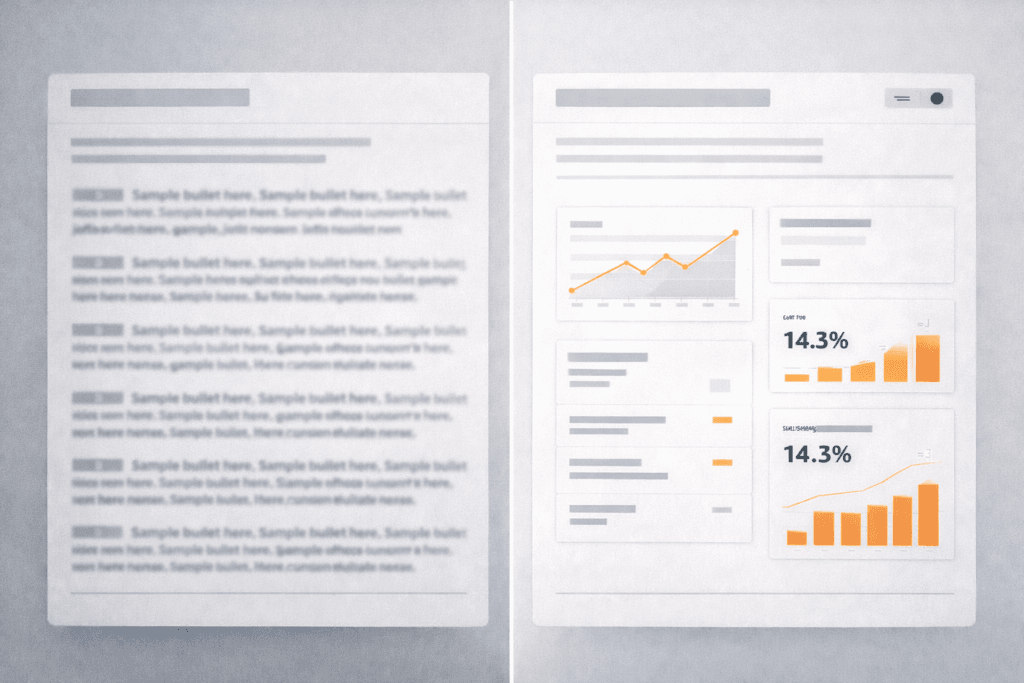
What Changed: Amazon’s Shift from Keyword Matching to Performance Signals
For years, Amazon SEO was straightforward: identify your target keywords, include them in your title and bullets, repeat them in backend search terms, and you’d rank. The more times a keyword appeared, the better your chances of showing up in search results.
That model broke down around 2022–2023 when Amazon began prioritizing performance signals over keyword density. The A9 algorithm evolved to become more sophisticated—more like Google’s ranking system, where user behavior matters more than keyword frequency.
Here’s what Amazon prioritizes now:
- Conversion rate: How many people who see your listing actually buy. This is the single biggest ranking factor.
- Click-through rate (CTR): How often people click your listing when it appears in search results.
- Sales velocity: How many units you sell in a given time period, especially in the first 30–90 days after launch.
- Customer satisfaction: Reviews, ratings, return rate, and A-to-Z claims all feed into your ranking.
- Relevance: Whether your product actually matches the search intent behind a keyword. This is where semantic understanding comes in—Amazon can now infer relevance without requiring exact keyword matches.
Keywords still matter—you can’t rank for terms that don’t appear anywhere in your listing. But keyword density is no longer the lever it used to be. Amazon cares more about whether people buy from you than how many times you mention “stainless steel water bottle” in your title.
The shift: Amazon moved from keyword-first ranking to performance-first ranking. If your listing converts well, Amazon will show it for related searches—even if you didn’t explicitly optimize for those keywords.
Why Keyword Stuffing Now Hurts More Than It Helps
Here’s the trap most brands fall into: they think more keywords = more visibility. So they cram every possible variation into their title, stuff bullets with redundant search terms, and wonder why their organic rank is stuck.
The reality? Keyword stuffing actively degrades your performance in three ways:
1. It Destroys Conversion Rate
When you prioritize keywords over clarity, you create listings that are confusing and hard to read. Customers don’t buy from listings that look like a wall of search terms—they buy from listings that clearly communicate what the product is, who it’s for, and why it solves their problem.
Compare these two title approaches:
Keyword-stuffed title:
“Stainless Steel Water Bottle Insulated Water Bottle Leak Proof Water Bottle BPA Free Water Bottles for Women Men Kids Travel Gym Hiking Sports 32oz”
Conversion-optimized title:
“HydroFlask 32oz Wide Mouth Water Bottle – Insulated Stainless Steel, Leak Proof, Keeps Drinks Cold 24 Hours”
The first title hits more keyword variations. The second title converts better because it’s clear, branded, and benefit-driven. And because it converts better, Amazon will rank it higher—even for keywords that don’t appear in the title.
At $10M+ in revenue, a 1–2% drop in conversion rate from poor listing copy can cost you hundreds of thousands in annual revenue. Keyword stuffing isn’t free—it’s expensive.
2. It Kills Click-Through Rate
When customers search on Amazon, they scan titles and images in under 2 seconds. If your title is a jumbled mess of keywords, they skip it—even if your product is exactly what they need.
Low click-through rate signals to Amazon that your listing isn’t relevant for that search term. So Amazon stops showing it. You might technically rank for a keyword, but if you’re on page 3 because no one clicks, it doesn’t matter.
The brands winning on Amazon in 2025 optimize for clarity and differentiation first, keywords second. Their titles and images immediately communicate:
- What the product is
- Who it’s for
- Why it’s different from the 50 other options on the same search results page
3. It Triggers Algorithmic Suppression
Amazon’s algorithm can detect when listings are over-optimized. If your title is 200 characters of pure keyword stuffing with no brand or differentiators, Amazon may suppress your listing in search results—not because you violated policy, but because the algorithm determines your listing provides a poor customer experience.
This is especially true for competitive keywords. Amazon doesn’t want the top 10 search results to all look identical. Listings that prioritize clarity and differentiation get rewarded. Listings that look like every other generic product get buried.
Bottom line: Amazon’s algorithm in 2025 is optimizing for customer satisfaction, not keyword frequency. If your listing strategy is still rooted in keyword density, you’re fighting the algorithm—not working with it.
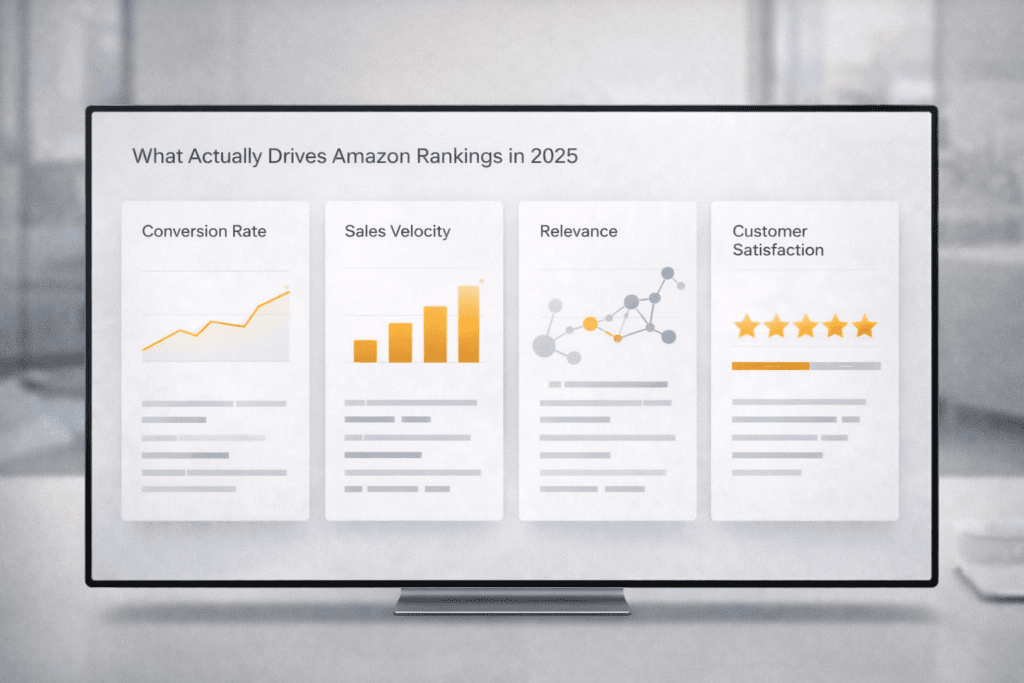
What Actually Drives Rankings in 2025: The Four Levers
If keyword density doesn’t matter anymore, what does? Top-performing brands focus on four levers that directly impact Amazon’s ranking algorithm:
Lever #1: Conversion Rate (The Ranking Multiplier)
Conversion rate is the single biggest ranking factor on Amazon. If your listing converts at 15% and your competitor’s converts at 10%, you’ll rank higher—even if their listing has better keyword optimization.
Why? Because Amazon makes money when customers buy, not when they search. A high-converting listing drives more revenue per impression, so Amazon shows it more often.
What drives conversion rate:
- Clear, benefit-driven title: Customers should know exactly what they’re buying in 2 seconds.
- Professional images: High-resolution lifestyle images that show the product in use, not just white background shots.
- Compelling bullet points: Focus on benefits and outcomes, not just features. Answer the customer’s question: “What’s in it for me?”
- Social proof: 50+ reviews with 4.3+ star average. Reviews matter more than ever because they’re a trust signal that directly impacts conversion.
- Competitive pricing: You don’t need to be the cheapest, but you need to be within 10–15% of the average price point for your category.
- A+ Content: Enhanced brand content that tells your product story visually. Brands with A+ Content see 3–10% higher conversion rates on average.
At scale, improving conversion rate from 12% to 15% doesn’t just increase revenue by 25%—it multiplies your organic rank, which drives even more traffic. This is the compounding effect that most brands miss.
Action: Run A/B tests on titles, images, and bullet points. Amazon’s Manage Your Experiments tool is free for Brand Registry users. Test one variable at a time and let it run for 10+ weeks to get statistical significance.
Lever #2: Sales Velocity (The Launch Accelerator)
Amazon rewards products that sell consistently. If you launch a new product and generate 50 sales in the first week, Amazon will boost your organic rank to test whether you can maintain that velocity. If you do, the boost becomes permanent. If you don’t, you drop back down.
This is why product launches require a concentrated sales push in the first 30–90 days. You’re not just trying to generate revenue—you’re trying to signal to Amazon that this product deserves higher placement in search results.
How top brands drive early sales velocity:
- Aggressive PPC in the first 60 days: Run at 50–80% ACOS to maximize impressions and clicks. You’re willing to operate at break-even or slight loss to build ranking momentum.
- Launch promotions: Coupons, Lightning Deals, or Prime Exclusive Discounts to drive early conversions and reviews.
- External traffic: Drive traffic from your email list, social media, or influencer partnerships. External traffic with high conversion rates signals to Amazon that this product has demand beyond their platform.
- Review generation: Use Vine, Request a Review button, and inserts to generate 15–25 reviews in the first 30 days. Reviews are a trust signal that directly impacts conversion rate.
The mistake most brands make? They launch a product, run minimal PPC, and hope for organic traction. That doesn’t work in 2025. You need to force velocity in the first 60–90 days to earn your organic rank.
Rule of thumb: Budget 2–3x your normal ACOS target for the first 60 days of any new product launch. This is your investment in organic rank, not just short-term revenue.
Lever #3: Relevance Through Semantic Matching (Not Just Exact Keywords)
Amazon’s algorithm now understands semantic relationships between keywords. This means you don’t need to include every variation of a keyword to rank for it.
For example:
- If your listing mentions “yoga mat” and “non-slip,” Amazon will show you for “non-slip yoga mat”—even if that exact phrase doesn’t appear in your listing.
- If you sell “stainless steel water bottles” and your listing includes “keeps drinks cold 24 hours,” Amazon will surface you for “insulated water bottle”—because it understands the semantic relationship between insulation and temperature retention.
This is a massive shift. In 2019, you had to include every possible keyword variation to rank. In 2025, Amazon infers relevance based on context, user behavior, and semantic relationships.
What this means for your listing strategy:
- Focus on natural language: Write for humans, not for algorithms. If your title reads like a string of keywords, rewrite it.
- Use descriptive language: Instead of repeating “water bottle” 10 times, describe features and benefits that help Amazon understand what your product does.
- Leverage backend search terms strategically: Use backend fields for synonyms, misspellings, and alternate phrasing—not for repeating what’s already in your title and bullets.
The upside: You can rank for hundreds of long-tail variations without explicitly optimizing for each one. The algorithm does the heavy lifting if your listing is clear and contextually rich.
Lever #4: Customer Satisfaction Signals (The Long-Term Moat)
Amazon tracks customer satisfaction at the product level through multiple signals:
- Return rate: High return rates signal product-market misfit or misleading listings. Amazon will suppress rankings.
- Review velocity and sentiment: Products that consistently generate positive reviews get a ranking boost. Products that generate negative reviews get suppressed.
- A-to-Z claims and chargebacks: These are massive red flags that tell Amazon the product or seller experience is problematic.
- Customer questions: Products with answered questions rank better because Amazon sees this as a proxy for customer engagement and listing clarity.
The brands that dominate Amazon long-term don’t just optimize listings—they optimize the entire customer experience. They:
- Set clear expectations in their listings so customers know exactly what they’re buying
- Use inserts to drive reviews and answer common questions proactively
- Monitor reviews weekly and address recurring complaints in product updates or listing copy
- Respond to customer questions within 24 hours to maintain engagement signals
This is the long-term moat. You can’t fake customer satisfaction. If your product is good and your listing sets accurate expectations, these signals compound over time and create a ranking advantage that’s nearly impossible for competitors to overcome.
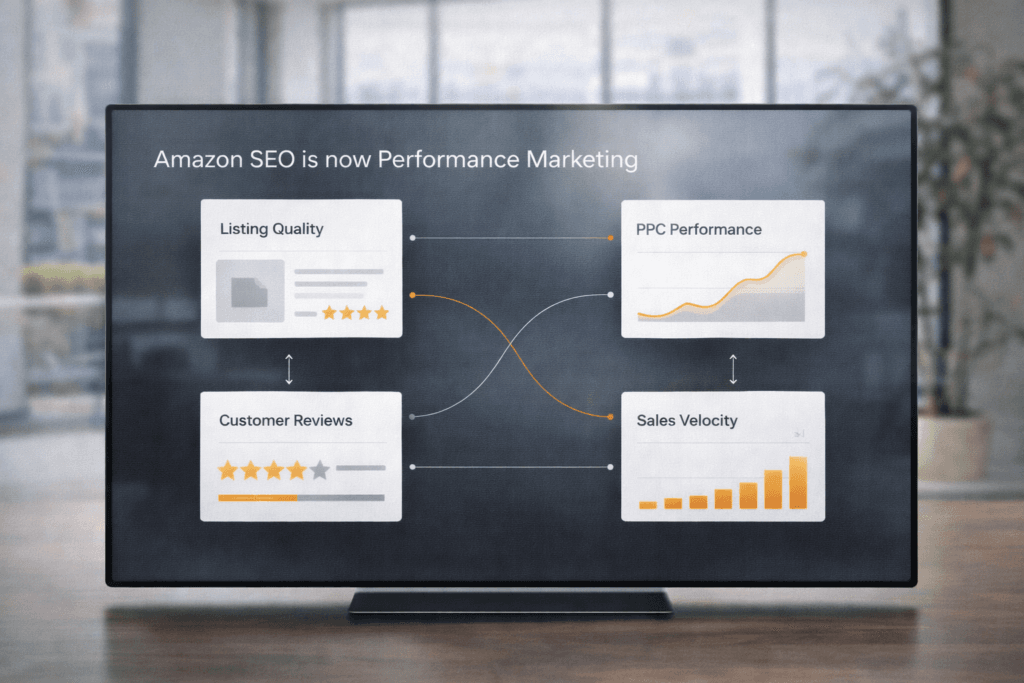
The Modern Amazon SEO Framework: Conversion-First, Keywords Second
If you’re rethinking your Amazon SEO strategy for 2025, here’s the framework top-performing brands use:
Step 1: Identify Core Keywords (But Don’t Obsess Over Density)
You still need to know which keywords matter. Use tools like Helium 10, Jungle Scout, or Cerebro to identify:
- High-volume keywords with commercial intent (e.g., “best yoga mat for hot yoga”)
- Long-tail keywords that signal purchase intent (e.g., “non-slip yoga mat for sweaty hands”)
- Competitor keywords where you have product differentiation
But don’t try to include every variation in your listing. You only need to include:
- Your 3–5 primary keywords in the title
- Supporting keywords in bullets (naturally, not forced)
- Synonyms and variations in backend search terms
Step 2: Write for Conversion, Not for Keywords
Once you know your keywords, write your listing copy to maximize conversion rate:
- Title: Brand + Primary Keyword + Key Differentiator. Keep it under 150 characters if possible. Prioritize clarity over keyword count.
- Bullets: Lead with benefits, not features. Answer: What problem does this solve? Who is this for? Why should I choose this over competitors?
- Description + A+ Content: Tell the brand story. Use visuals to show the product in context. Focus on lifestyle and outcomes, not just specs.
Test your listing copy: If you read it out loud and it sounds like a robot wrote it, customers won’t convert. Rewrite it.
Step 3: Invest in Visual Assets That Drive Clicks and Conversions
Images are the first thing customers see. If your images are generic white-background product shots, you’re losing to competitors with lifestyle images that show the product in use.
What works in 2025:
- Main image: Clean, high-resolution product shot on white background (required by Amazon)
- Images 2–3: Lifestyle shots showing the product in use with real people
- Images 4–5: Infographics highlighting key features and benefits
- Images 6–7: Size comparisons, packaging, or additional angles
- Video: 30–60 second product demo showing how it works in real life
Budget: $500–$2,000 for professional product photography. This is not optional at scale. Good images pay for themselves 10x over in conversion rate lift.
Step 4: Drive Sales Velocity Through PPC and Promotions
Organic rank is earned through performance. You need to prove to Amazon that your listing converts before it will show you organically.
Launch strategy:
- Week 1–4: Aggressive PPC (50–80% ACOS) to drive impressions and early conversions
- Week 4–8: Add promotions (coupons, deals) to accelerate sales velocity and review generation
- Week 8–12: Scale back PPC to target ACOS as organic rank improves
The goal: Generate 50–100 sales in the first 30 days to trigger Amazon’s ranking algorithm. This creates momentum that compounds over time.
Step 5: Monitor and Iterate Based on Performance Data
Amazon SEO isn’t a set-it-and-forget-it strategy. You need to continuously monitor performance and iterate:
- Weekly: Check conversion rate, click-through rate, and organic rank for your top 10 keywords
- Monthly: Review search term reports from PPC to identify new keywords you should target organically
- Quarterly: Run A/B tests on titles, images, and bullets to optimize for conversion
If conversion rate drops, diagnose why: Is it pricing? Reviews? Listing copy? Images? Fix the root cause, don’t just adjust keywords.

Common Mistakes Brands Still Make in 2025
Even at $10M+ in revenue, we see brands making these critical SEO mistakes:
Mistake #1: Treating All Keywords Equally
Not all keywords drive the same value. A keyword with 10,000 monthly searches and 2% conversion rate is less valuable than a keyword with 1,000 monthly searches and 15% conversion rate.
Focus on high-intent, high-conversion keywords first. Volume doesn’t matter if people don’t buy.
Mistake #2: Ignoring Mobile Optimization
Over 70% of Amazon traffic comes from mobile. If your title is 200 characters, customers on mobile only see the first 80–100 characters before it gets cut off.
Put your most important information—brand, primary keyword, key differentiator—in the first 80 characters of your title.
Mistake #3: Not Using Brand Registry Features
If you’re Brand Registered and not using A+ Content, Brand Story, and Manage Your Experiments, you’re leaving 5–10% conversion rate lift on the table.
These tools are free. Use them.
Mistake #4: Copying Competitor Listings
Competitor research is useful for keyword discovery. But copying their listing strategy word-for-word means you’ll never differentiate. Amazon rewards unique, high-converting listings—not generic clones.
Study competitors to understand the category. Then differentiate your positioning, messaging, and visuals to stand out.
The Bottom Line: Amazon SEO is Now Performance Marketing
The shift from keyword density to performance signals means Amazon SEO is no longer a technical optimization exercise—it’s performance marketing.
You can’t hack your way to page 1 by stuffing keywords into your listing. You need to:
- Build listings that convert at 12%+
- Drive consistent sales velocity through PPC and promotions
- Maintain high customer satisfaction through product quality and clear expectations
- Continuously test and optimize based on performance data
At $10M+ in revenue, the brands winning on Amazon aren’t the ones with the best keyword research—they’re the ones with the best customer experience. Amazon’s algorithm rewards that. If you’re still optimizing for keyword density in 2025, you’re optimizing for the wrong outcome.
The good news? This shift levels the playing field. Smaller brands with better products and better customer experiences can outrank bigger competitors—even if those competitors have more reviews and bigger ad budgets.
At AmzCentric, we help brands rethink their Amazon SEO strategy around performance, not keywords. If your organic rank has plateaued or you’re not seeing the lift you expected from listing optimization, we can audit your approach and identify what’s actually holding you back.
But whether you work with us or not, start with the fundamentals: optimize for conversion first, keywords second. That’s how Amazon’s algorithm works in 2025—and fighting it is expensive.