
Writen by
Zain Zakir
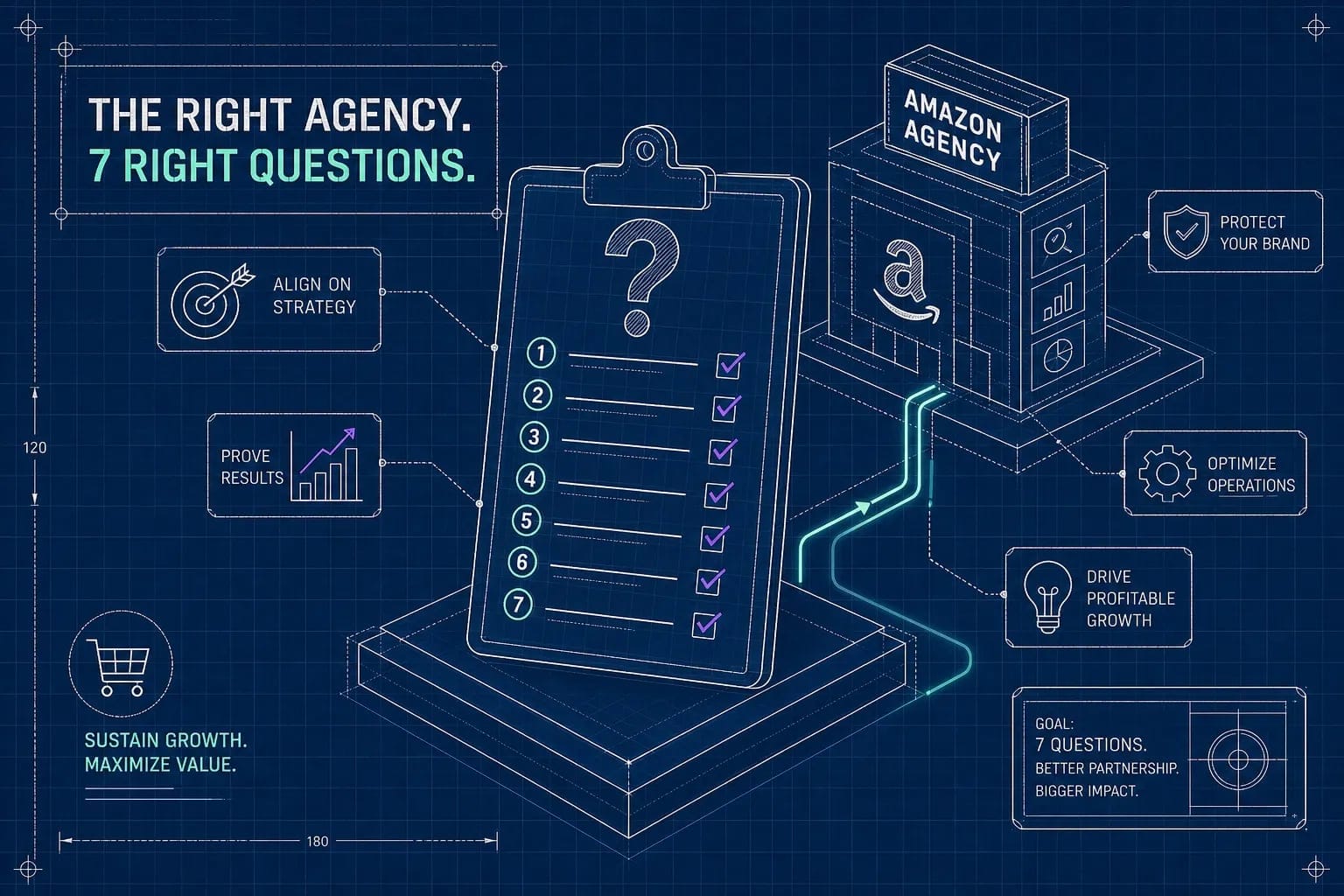
Most six-figure brand owners don’t lack ambition. What they lack is a framework for vetting agencies before signing a contract. The result is predictable: they choose based on a polished pitch deck, a few glowing testimonials, and a confident sales call. Then they spend the next six months watching ACoS creep upward while monthly reports arrive full of graphs that explain nothing actionable.
If you’re asking how do I choose the best Amazon agency for a 6-figure brand, start with these seven diagnostic questions. After working with Amazon brands across categories for over a decade, the single most predictable failure point isn’t the market, the competition, or the algorithm, it’s mismatched expectations with an agency that wasn’t built for what the brand actually needed. The agencies that consistently move the needle share specific characteristics in how they structure strategy, communicate results, and own accountability. This guide is built around those characteristics, packaged as seven questions you should ask before signing anything.
Walk through all seven with any agency you’re evaluating, and you’ll walk out of that conversation knowing whether they’re a genuine growth partner or a managed-service vendor dressed up in agency clothing. That distinction is worth everything at the six-figure stage.
Why most six-figure brands end up with the wrong agency
The root cause isn’t bad luck. Most agencies get selected based on presentation quality, not operational fit. Brands get dazzled by case studies that look polished but lack attribution, or they pick the cheapest option under the assumption that running Amazon ads can’t be that complicated. Both paths lead to the same place: wasted budget and stalled growth.
Two failure modes show up repeatedly at the six-figure stage. The first is agencies that only manage PPC with no coherent view on organic growth, so your ACoS looks acceptable while your organic rank quietly deteriorates. The second is agencies that promise “full service” but deliver siloed work where ads, listings, and conversion optimization operate as three separate jobs with no connective tissue between them.
At $100K to $1M in annual Amazon revenue, you’re generating real money but you probably don’t have an in-house Amazon expert. That asymmetry of knowledge creates the perfect environment to be sold on activity rather than outcomes. The seven questions below are designed to function as a diagnostic, not a standard interview checklist.
The cost of a bad hire goes beyond the monthly retainer
The financial exposure adds up faster than most brands expect. Factor in retainer fees plus misallocated ad spend during a misaligned engagement, and you can easily burn through $30,000 to $60,000 before you realize the relationship isn’t working. That’s real capital that could have funded inventory, creative production, or a better agency from the start.
The opportunity cost is harder to quantify but arguably more damaging. Six to twelve months of stalled organic rank, declining conversion rates, and competitors consolidating market share while you’re mid-agency-transition is the kind of setback that takes years to fully recover from at this stage of growth.
What a good agency partnership actually looks like
The integrated model is the benchmark. PPC, SEO, and conversion optimization should operate as one growth system, not three separate line items managed by three different people who rarely talk to each other. When those three levers pull in the same direction, growth compounds. When they operate in isolation, they cancel each other out. Keep that picture in mind as you work through the questions below.
How do I choose the best Amazon agency for a 6-figure brand? Start with these 7 questions.
1. Do you run an integrated growth strategy, or manage PPC and SEO separately?
This is the right question to ask first because the answer reveals how the agency actually thinks about your account. A siloed operation might improve your ACoS while your organic rank stagnates, or it might refresh your listing copy without aligning it to the keywords your active campaigns are bidding on. Both scenarios represent real money left on the table.
An integrated approach looks like this in practice: the same keyword research that informs your campaign build also shapes your listing optimization and A+ content strategy. Bid adjustments respond to changes in organic rank, not just spend efficiency. The conversion goals your ads are driving toward are reinforced at the listing level. When these elements are coordinated, each improvement multiplies the others.
What to listen for: agencies that describe a clear, documented process connecting PPC, SEO, and conversion rate optimization are worth a closer look. Agencies that describe listing optimization and PPC management as separate packages you can purchase independently are signaling exactly the kind of siloed structure you want to avoid.
Questions to ask inside this question
Ask them to walk through a specific scenario: if organic rank on a target keyword drops, what do they do with the PPC strategy, and how quickly? Ask who owns listing copy decisions: is it the PPC manager, the SEO specialist, or a shared team with a defined handoff process? The specificity of their answer tells you more than any general claim about being “full service.”
The benchmark to measure against
At AmzCentric, the unified growth framework treats SEO, PPC, and conversion rate optimization as a single system where every element reinforces the others. In practice, that means keyword data flows directly from campaign research into listing copy and A+ content, the same priority terms driving bid decisions also shape title structure and bullet points. That alignment is what produces compounding, long-term growth rather than ad-dependent revenue spikes that flatten the moment spend drops. Use this integrated model as your benchmark when evaluating any agency’s answer to this question.
2. What does your reporting actually show, and how does it connect to profitability?
The reporting problem is industry-wide. Most agency reports show activity, impressions, clicks, total spend, rather than outcomes. They’re built to look busy, not to drive decisions. If every metric in a monthly report could just as easily be ignored without changing what you do next month, the report is theater.
Useful reporting at the six-figure level includes TACoS trending month over month, the organic versus paid revenue split, conversion rate by listing, ranking movement on your priority keywords, and ACoS measured against your specific break-even threshold rather than a generic industry benchmark. These are the numbers that tell you whether the strategy is working or needs to change.
The decision-support test is simple: every metric in a report should answer the question “what do we do differently next month because of this?” If the report doesn’t change behavior, it isn’t serving you.
AmzCentric’s reporting model
AmzCentric builds reporting around rankings, conversion rates, ad efficiency, and profitability, not vanity metrics. Every report is designed to show exactly what’s working and why, giving brand owners full visibility rather than a curated summary that flatters the agency regardless of actual performance. That’s the level of granularity you should request from any agency before signing. If they can’t articulate it during the sales process, expect less after the contract is signed.
What to ask for in a reporting sample
Request a sample report from a current or past client, redacted if necessary. Pay attention to whether it shows trend data over time or just point-in-time snapshots. A single month’s data tells you almost nothing useful. Then ask: “What decision did your last monthly report lead to for a specific client?” A competent agency answers this immediately with specifics. A weak agency pivots to describing what the report contains rather than what it caused.
3. Can you show proof from a brand at my stage and in my category?
Generic case studies don’t validate fit. A case study from a $5 million supplement brand doesn’t tell you much about what this agency can do for a $300,000 home goods brand. PPC competition dynamics, review velocity, listing strategy, and seasonal patterns vary dramatically by category and by revenue stage. You need proof that matches your situation, not proof that matches their best month ever.
What to request: three to five case studies that match your revenue range ($100K to $1M), your category or an adjacent one, and your primary challenge, whether that’s improving organic rank, reducing ACoS, fixing conversion rate, or scaling profitably. Strong proof includes a specific starting point, a clear description of what the agency changed and why, a timeline for when results appeared, and measurable before-and-after numbers with a baseline.
The reference check most brands skip
Ask to speak directly with two or three clients, ideally one current and one former. Former clients often give you the most honest picture of how the agency handles underperformance, communication gaps, and difficult months. Specific questions worth asking: Did results match what was promised? How did they handle a month where things didn’t go according to plan? Would you hire them again, and why?
Red flags in case study responses
Testimonials without quantified results, case studies without timelines, and responses of “we can’t share client data” with no alternative proof are all signals to treat cautiously. The same applies to an agency that can’t explain their attribution methodology, meaning they can’t separate their impact from organic market movement. If they can’t make that distinction clearly, you can’t trust them to manage your budget responsibly.
4. What metrics will you commit to in the first 90 to 180 days?
Any credible agency should be able to tell you what “good” looks like for your account at 90 days and 180 days, and explain the reasoning behind those targets. Based on observed performance across growth-stage brands, a competent agency should be targeting the following benchmarks by months three to six:
- ACoS: 20 to 35 percent range
- TACoS: trending down toward 12 to 20 percent from launch-phase highs
- Conversion rate: 8 to 15 percent zone
- ROAS: 3x to 5x depending on your margin structure
One nuance worth understanding upfront: the first 60 to 90 days often look worse before they look better. A competent agency restructures campaigns, builds keyword data, and tests creative during this window. ACoS can temporarily sit in the 30 to 50 percent range before efficiency improves. A trustworthy agency tells you this in the sales call rather than promising instant wins that set up early disappointment.
How to interpret their answer
If an agency commits to specific outcome targets without first asking about your margin structure, your current performance baseline, or your category’s competitive dynamics, they’re selling, not planning. Targets set without context are promises designed to close deals, not benchmarks designed to measure results. On the other hand, if they refuse to commit to any directional benchmarks at all, that’s equally concerning. Accountability requires a target.
TACoS as the primary health metric for six-figure brands
TACoS, total ad cost of sales as a percentage of total revenue including organic, is a more honest measure of agency impact than ACoS alone. ACoS only measures efficiency within your paid campaigns. TACoS measures whether organic growth is absorbing more of the revenue burden over time. A declining TACoS trend over three to six months is the clearest signal that an integrated strategy is actually working, because it means your organic flywheel is spinning without requiring proportional increases in ad spend.
5. How is your pricing structured, and what is actually included?
For brands in the $100K to $1M annual revenue range, flat monthly retainers are the most common Amazon agency pricing model in 2026. Narrower PPC and listing support typically runs $1,500 to $5,000 per month. Broader full-service management, covering PPC, listing optimization, creative, account health, and strategy, generally runs $3,000 to $8,000 per month. Agencies pricing on a percentage of ad spend typically charge 10 to 20 percent of managed spend, so a brand running $10,000 per month in ads might pay $1,000 to $2,000 in management fees under that model.
The critical question isn’t just “what do you charge.” It’s “what is not included.” Creative production for A+ content, infographics, and video, brand store design, audit work, and international expansion support are frequently add-ons that inflate the real monthly cost well above the headline retainer number. Get a complete breakdown before making any comparisons.
Matching pricing model to your growth stage
Retainer models favor brands that want budget predictability and aren’t dramatically scaling ad spend month over month. Percentage-of-spend models can misalign incentives: if the agency earns more when you spend more, their interest in efficiency is inherently limited. Hybrid models, combining a lower base retainer with a performance bonus tied to specific outcomes, are worth exploring because they create shared upside without making the entire fee contingent on results the agency only partially controls.
What a transparent pricing conversation looks like
Ask for a full-scope breakdown: every service included, every service excluded, and the fee structure for each. Then ask what a realistic all-in monthly cost looks like for the first six months, including creative production, reporting, strategy calls, and any onboarding fees. Agencies that can answer this question clearly and completely are demonstrating the kind of transparency you want from a long-term partner.
6. What do the contract terms say about performance accountability and exits?
Standard contract terms should cover the specific scope of work, the fee structure, the contract term with a clear exit notice requirement, asset ownership provisions after payment, and the reporting cadence, all spelled out in writing. These aren’t unusual requests. They’re table stakes for a professional engagement.
The accountability gap in most agency contracts is that they specify deliverables (PPC management, monthly reporting calls) but not outcomes. “Best efforts” language with no KPI commitment means the contract protects the agency, not you. At minimum, push for a defined set of KPI targets at months three and six, an agreed review point where both sides formally assess fit, and a reasonable exit clause. Sixty-day notice is standard; anything longer with no performance-out provision is a red flag worth stopping the conversation over.
Contract red flags to identify before signing
Long lock-in periods of six to twelve months with no performance-out option, vague deliverables described loosely as “full service,” and clauses that give the agency ongoing rights over your listings, ad accounts, or creative assets should all slow you down before you sign. Unilateral change clauses, terms that allow the agency to modify pricing or scope without your consent, are the clearest signal of a contract designed to retain you rather than serve you.
Asset ownership is non-negotiable
Confirm in writing that all listings, copy, A+ content, campaign structures, and keyword data belong to you once payment has been made. This isn’t a minor detail. Agencies that claim ownership of work product as leverage for retention aren’t partners; they’re landlords. You should be able to take everything you’ve paid for and walk away cleanly if the relationship ends for any reason. Once the contract terms are solid, the next layer to examine is who will actually be doing the work.
7. Who will actually manage my account, and how will we communicate?
The bait-and-switch is one of the most common disappointments in agency relationships. A senior strategist closes the deal with an impressive presentation, then hands the account to a junior coordinator managing fifteen other clients, with monthly check-in calls as the only real touchpoint. You don’t find out until you’re already two months in and wondering why nothing is moving.
Ask directly: who is the specific person managing my account day to day, and what does their current client load look like? Then request to speak with that person before signing, not just the sales lead. Weekly or biweekly strategy calls plus monthly performance reports are the standard for growth-stage accounts. Less frequent communication than that suggests the agency is spreading their team too thin.
Evaluating the actual team, not the pitch team
Request a walkthrough of who handles PPC, who handles listing optimization, and who manages account health. Are these the same person or a coordinated team with defined responsibilities? Then ask how the agency handles urgent situations: a listing suppression on your top ASIN, a hijacker stealing the buy box, or a sudden account health flag. Their answer reveals whether they have an operational system with defined response protocols or an ad hoc culture that figures things out as they come up.
Accountability in practice
The best agencies build accountability into their communication model, not just their contracts. Ask whether you’ll have access to a live performance dashboard between calls, how quickly they respond to questions outside scheduled meetings, and what the escalation path looks like when something goes wrong. Agencies that can answer these questions with confidence and specificity have built systems to support clients at scale. Agencies that answer vaguely are telling you something important about how they operate.
Choosing an Amazon agency for a 6-figure brand: what to do before you make the final call
The seven questions above are designed to stress-test one core thing: whether the agency operates as an accountable growth partner or a managed-service vendor that runs your ads and sends reports. The distinction matters enormously at the six-figure stage, where every month of stalled growth has a compounding cost and competitors aren’t slowing down while you figure out the agency relationship isn’t working.
The agencies worth working with will welcome every one of these questions. They’ll have specific answers, real proof points, and a clear willingness to commit to outcomes rather than just activity. The agencies worth avoiding will hedge, deflect, pivot back to case studies, or redirect toward new slides. That pattern tells you everything you need to know before you’ve spent a dollar.
When you’re deciding how do I choose the best Amazon agency for a 6-figure brand, use these seven questions to cut through the pitch noise and find out what an agency actually does, not just what they claim. The framework AmzCentric uses across its client base reflects the integrated model, outcome-focused reporting, and brand-first philosophy described throughout this guide. These aren’t positioning statements; they’re operational standards built in direct response to the failure modes this article describes. Take these questions into your next agency conversation and see how quickly the dynamic changes.
