
Writen by
Zain Zakir
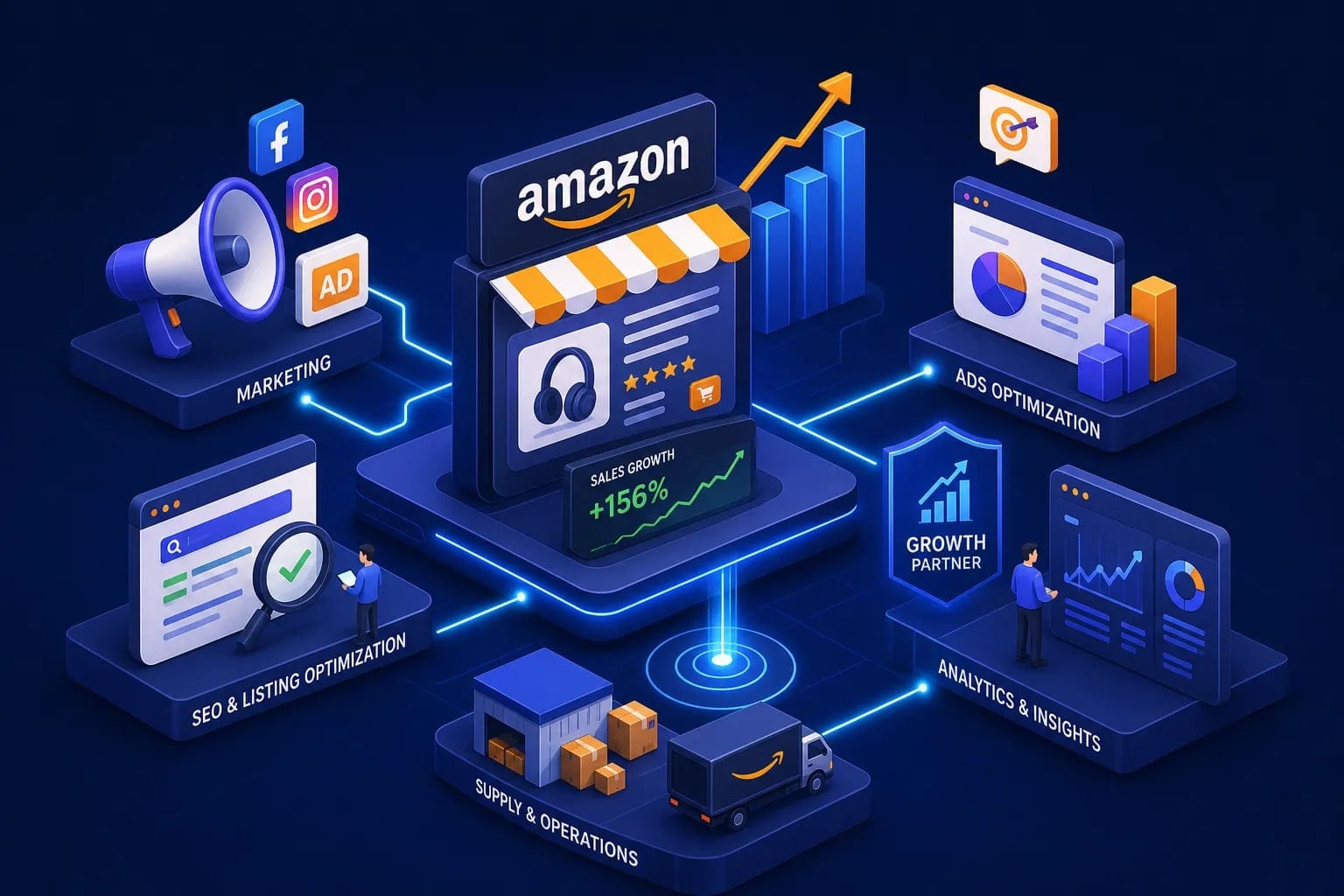
Most brands hiring an Amazon growth agency think they’re hiring someone to manage their ads. That’s a reasonable assumption, and it’s wrong more often than not. A real Amazon growth agency manages the entire system that turns traffic into revenue, not just the budget that buys the traffic.
This guide breaks down what these agencies actually do, what a reasonable engagement costs in 2026, and how to evaluate one before you write a check. If you’ve been burned by a siloed ads-only shop before, or you’re hiring an amazon growth agency for the first time, this is the clearest version of what you need to know.
The six core services a full-service Amazon growth agency covers
When most sellers think about hiring outside help, they picture ad management. That’s one piece. A genuinely full-service Amazon growth agency covers six distinct functions: paid advertising, listing optimization and SEO, creative production and CRO, account operations, brand protection, and inventory and launch strategy. The agencies doing real work run all of them, not just the one that’s easiest to report on.
Paid advertising: sponsored ads and beyond
A serious Amazon advertising agency manages more than Sponsored Products. The real work includes Sponsored Brands, Sponsored Display, and Amazon DSP for full-funnel retargeting and prospecting. These campaigns need to be structured around margin and organic share, not just ACOS. If your agency only talks about bids and budgets, they’re missing the strategic layer entirely.
Listing optimization and Amazon SEO
Strong Amazon listing optimization is not stuffing keywords into a title. It’s researching how your category actually searches, writing conversion-focused copy, optimizing backend fields, and then tracking whether rankings move. This is the organic foundation that makes paid traffic more efficient. Without it, you’re paying for clicks that land on a listing that can’t convert. A dedicated Amazon listing optimization agency approach means treating copy, keywords, and creative as parts of the same system, not separate tasks handed off to different people.
Creative: A+ content, storefronts, and imagery
Creative is where most brands leave money on the table. Product photography, A+ Content, Brand Story, and storefront design all affect conversion rate directly. An agency that doesn’t touch creative is leaving a major variable unmanaged. You can have perfect keyword targeting and still lose the sale because your main image doesn’t stop the scroll.
Account operations, health, and brand protection
Catalog issues, suppressed listings, unauthorized sellers, and Seller Central compliance problems don’t fix themselves. A full-service agency includes operational coverage so brand owners aren’t firefighting alone. Brand protection is frequently overlooked by smaller shops and can be a significant, sometimes hidden, source of revenue loss for established brands, particularly when counterfeit listings or unauthorized sellers quietly erode Buy Box share and organic ranking.
Inventory management and launch strategy
Stockouts kill ranking momentum. Overstock ties up cash. A serious Amazon growth agency builds inventory planning and new product launch strategy into the engagement from the start, not as an afterthought. If these functions aren’t covered, growth campaigns routinely outpace supply, and the gains evaporate the moment a product goes out of stock.
Analytics and performance reporting
The sixth function is the one that holds the other five together: measurement. An integrated agency tracks TACoS, organic rank, contribution margin, and conversion rate, not just ACOS, and connects every service line to the same performance baseline. Without this, each function operates in its own silo with its own metrics, and no one owns the actual business outcome.
How an Amazon growth agency packages its services
The packaging matters as much as the services themselves. What an agency calls “full-service” and what it actually delivers can be very different things. Before you compare quotes, understand how the service stack is structured.
The full-service retainer vs. ads-only management
Some agencies pitch “full-service” but deliver PPC management with quarterly check-ins. Real full-service means all six core functions are actively managed by the same team under the same strategy. Before signing, ask specifically which services are included versus available as paid add-ons. Brands that don’t ask that question upfront often discover the scope they assumed they were getting carries a significant premium on top of the base retainer, sometimes materially more than the quoted fee.
Tiered packages and what each level covers
Most agencies structure three tiers: starter (usually PPC plus basic listing support), growth (adds creative and operations), and enterprise (full catalog management, DSP, analytics, and dedicated strategy). The tier you need depends on your revenue stage and how much operational complexity you’re dealing with. A brand doing $500K per year needs a different scope than one managing a catalog of 200 SKUs across multiple marketplaces.
Modular extras to watch for
International marketplace expansion, Amazon DSP, and brand protection are commonly sold as add-on modules. That’s not inherently a problem, but you need to know what the base retainer actually covers so you’re not surprised when the invoice arrives. Get the full-scope breakdown in writing before you sign anything, including which services trigger additional fees when your account grows.
Amazon growth agency pricing and benchmarks (2026)
Pricing in this space is less standardized than most buyers expect. Four primary models exist, and the right one depends on how your business is structured and where your growth priorities sit.
The four pricing models and when each makes sense
The market runs on flat monthly retainers, percentage of ad spend, percentage of revenue, and hybrid models that combine a base fee with performance incentives. Flat retainers work well for brands that want predictable costs and a defined scope. Percentage-of-spend models align incentives when the engagement is heavily PPC-focused, though they can create a quiet conflict of interest around budget decisions, the agency’s incentive is to spend more, not necessarily to spend better. Revenue share models are more common in full-account growth partnerships where the agency has visibility into the whole business. Hybrid structures typically pair a lower base fee with a performance bonus tied to revenue or margin improvement, which creates cleaner alignment when profitability is the primary goal.
Real fee ranges by brand size
Entry-level management typically runs $1,500 to $3,000 per month. Mid-market, full-service Amazon growth agency engagements commonly fall in the $3,000 to $10,000 range. Enterprise programs with DSP, creative production, and deep operations support can reach $15,000 to $25,000 or more per month. For percentage-of-spend models, 10 to 20 percent of monthly Amazon ad spend is the standard range, and revenue share arrangements typically land between 3 and 10 percent of monthly Amazon sales. These ranges reflect commonly cited industry benchmarks and will vary based on scope, category, and the specific services included in your contract.
The number that actually matters is cost relative to contribution margin improvement, not the monthly fee in isolation. An agency charging $8,000 per month that improves your contribution margin by $25,000 delivers better economics than one charging $2,500 that doesn’t move the needle. Run that math before you let sticker price drive the decision.
Why a unified SEO, PPC, and CRO system outperforms siloed management
Brands that have worked with ads-only shops know this problem firsthand: spending more to buy the same revenue you had six months ago, while the agency dashboard looks fine the entire time. The services described above are not independent levers. They interact constantly, and how an agency manages those interactions determines whether you get compounding growth or a collection of decent-looking metrics that don’t add up to a better business.
What siloed management costs you in practice
When an agency only runs your ads, your organic rankings, conversion rate, and listing quality become someone else’s problem, or no one’s problem. PPC costs go up. ACOS climbs. The agency optimizes bids while ignoring the real reason the traffic isn’t converting. You end up spending more money to buy the same amount of revenue you had six months ago, and the agency’s dashboard looks fine the whole time.
The pattern shows up repeatedly when brands switch agencies: ACOS targets are being hit, but profit is actually declining. ACOS can look good even when TACoS is worsening, organic share is shrinking, and conversion rate is flat. Siloed management optimizes the metric it’s measured on, not the outcome you actually care about.
What an integrated approach actually looks like
At AmzCentric, keyword decisions, campaign structures, and listing updates are all aligned around the same set of goals. The SEO work supports PPC efficiency. The PPC data informs keyword prioritization for organic content. CRO improvements compound the impact of both. When one area improves, the others benefit, rather than each function operating in isolation with separate teams that rarely coordinate.
This is what “full-service” should mean, and it’s the clearest way to evaluate whether an Amazon PPC agency or Amazon marketing agency is genuinely integrated or just bundled services. Ask them directly: how does a change in listing copy affect your campaign structure? A strong answer comes immediately and connects specific functions. Hesitation is its own answer.
Realistic performance expectations at 3 and 6 months
Any agency that promises specific revenue numbers before auditing your account is selling you something. Real performance targets come from your baseline, not from an agency’s sales deck. That said, here’s what good progress actually looks like at each stage.
Month 1 through 3: what should actually happen
The first 90 days should be audit, realignment, and early optimization, not dramatic growth claims. Expect foundational work: keyword gaps identified, listing copy updated, campaign structure cleaned up, and reporting baselines established. A realistic early benchmark for accounts with obvious inefficiencies at the start is ROAS stabilizing around 3 to 4x and ACOS moving toward the 25 to 33 percent range. These figures vary significantly by category, margin structure, and baseline account health, treat them as directional, not guaranteed. If the account was already well-managed, early improvements will be smaller and more surgical.
Month 3 to 6: where real progress shows up
By month six, a serious agency should be demonstrating measurable improvement across both paid and organic performance. For accounts where creative and listing quality have been overhauled, strong results often include ROAS in the 4 to 6x range, ACOS dropping toward 17 to 25 percent, and conversion rate improvements of 10 to 20 percent. These are realistic outcomes when the full system is working, not universal guarantees. Results depend heavily on your product margin, category competitiveness, and where the account started. Sales growth should always be measured against your own prior-period baseline, not abstract industry averages.
Setting baseline-to-improvement targets from day one
The right agencies don’t promise universal benchmarks. They document your starting point across ACOS, TACoS, conversion rate, organic rank, and profitability, then tie their work to measurable improvement over those baselines. If an agency can’t articulate how they’ll measure success for your specific account before the contract starts, that’s the clearest possible warning sign. Measurement should be agreed upon before any work begins, not retrofitted to make the agency look good after the fact.
The questions you must ask before signing with any agency
Most brands ask the wrong questions in agency sales conversations. They ask about team size, years in business, and number of clients. Those things matter less than you think. Here’s what to actually ask.
Questions about experience and real proof
Ask to see three recent accounts similar to yours in category, price point, and complexity. Not their best wins. Not anonymous case studies. Named brands, specific starting metrics, the actions taken, and the outcomes. Ask whether you can speak directly with current clients, ideally in your category. The quality of that conversation tells you more than anything the agency will say in the pitch.
Questions about who actually does the work
Ask who manages your account day to day, how many other accounts that person handles, what their background and Amazon certification level are, and what happens if that person leaves. Agencies that can’t answer these questions clearly have a staffing structure that doesn’t support the level of service they’re selling. “Our team of specialists” is not an answer. You want a name, a background, and a number of accounts that person currently manages.
Questions about strategy, reporting, and accountability
Find out how they define success for your account and which metrics they optimize first. Request a sample report or redacted dashboard from a current client. Two questions in particular reveal how an agency behaves when things aren’t going well: do they track organic rank, BSR, conversion rate, and TACoS, or just ACOS? And how do they communicate proactively when performance drops? The answers to those questions matter more than anything in the pitch deck.
Red flags that tell you to keep looking
Some of these are obvious in hindsight but easy to miss in a polished sales conversation. Know what to look for before you’re sitting across from someone who’s very good at selling.
Warning signs in the sales conversation
If an agency opens with guaranteed rankings or specific revenue numbers before auditing your account, stop the conversation. Real experts give ranges based on your actual baseline, not promises designed to close a deal. Overly polished pitches with no concrete case study specifics are another warning sign. So is any agency that can’t name the person who will actually work on your account. Vague references to “our specialists” or “dedicated teams” are a tell.
Structural and contract red flags
Watch for long lock-in contracts with no performance clauses, fee structures that reward ad spend over profitability, and reporting that shows impressions and clicks without connecting those metrics to revenue and margin. If the agency owns your data, your ad account, or your Seller Central access and makes exit difficult, that’s a structural risk from day one. A good Amazon growth partner makes it easy for you to verify results and leave if they don’t deliver. Agencies that make exit hard are counting on inertia, not performance, to keep you around.
How to choose the right Amazon growth agency for your brand
You don’t need to evaluate 20 agencies. Evaluate four or five well and then make a clear decision. Here’s how to narrow the field efficiently.
The criteria that actually matter when building your shortlist
Three filters will eliminate most of the field. First, proof: named case studies with specific numbers, current client references you can contact, and a clear picture of who does the work. Second, integration: does the agency manage SEO, PPC, and CRO as one system, or are those handled by separate teams with no shared strategy? Third, accountability: does reporting tie to your profitability and margins, or to metrics that make the agency look good? An Amazon growth agency that can answer all three cleanly is worth a serious conversation. Most can’t.
- Named case studies with starting metrics, actions taken, and outcomes, not anonymous logos
- Current client references you can contact directly, ideally in your product category
- A clear answer for who manages your account daily and how many accounts they handle
- Reporting that includes TACoS, organic rank, conversion rate, and contribution margin, not just ACOS
- Contract terms that make exit straightforward if the agency underperforms
What the right agency looks like in practice
The right agency for your brand has worked with accounts at your revenue level, can demonstrate organic and paid results together, and builds reporting around your business goals rather than their own optics. AmzCentric’s Brand Care and Ad Care frameworks are built to operate as one integrated system, not two separate service lines that occasionally share a Slack channel. The SEO decisions reinforce paid efficiency. The paid data informs organic keyword prioritization. That’s the structure that produces compounding results instead of short-term spikes that flatten out by month four.
If you want to see how that integrated approach applies to your specific account, AmzCentric offers deep-dive audits that analyze listings, keywords, ads, competitors, and account health before any engagement begins. That’s the right starting point: not a pitch, but an honest look at where your account actually stands. Request a free Amazon growth agency audit to find out exactly what’s holding your account back.
The bottom line
Hiring an Amazon growth agency is not a decision you should make based on a polished deck or a referral alone. The agencies that actually move brands forward manage organic rankings, paid traffic, and conversion rate as one interconnected system, not three separate deliverables sold under one invoice.
Ask for the proof. Verify the team. Benchmark against your own baseline. If an agency can’t explain clearly how their SEO and PPC work together to improve your profitability, not just your ad metrics, keep looking. The right partner exists. You just have to ask the right questions to find them.
