
Written by
Zain Zakir
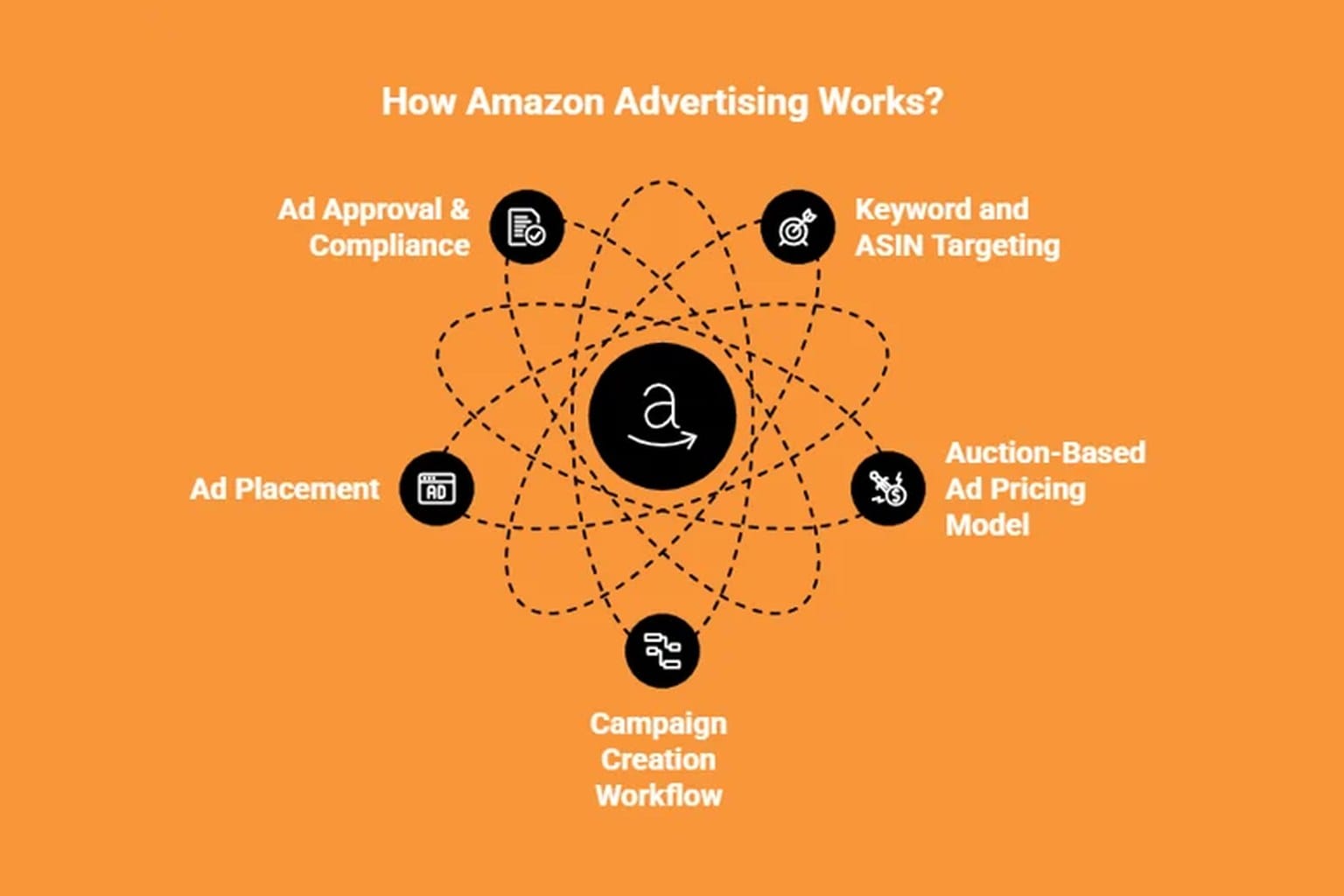
Amazon advertising is a pay-per-click auction inside the place where shoppers already buy. You pick products, choose keywords or products to target, set a bid and a daily budget, and pay when someone clicks. This Amazon advertising overview covers campaign types, costs, the console, and why ads and organic rank feed each other.
Amazon Advertising Overview: What You Are Actually Buying
On most ad networks you buy attention. On Amazon you buy a place in a shopping result. Shoppers search because they want to buy, and your ad competes with organic listings and other advertisers for the click.
Three things decide whether your ad shows and its cost:
- Relevance. Your product has to match the search or the product page being targeted.
- Your bid. The maximum you are willing to pay for a click.
- Eligibility. Amazon states that Sponsored Products ads only appear when the advertised item is in stock, and that products must be eligible for the Featured Offer to advertise (Amazon Ads, Sponsored Products).
If you lose the Featured Offer or run out of stock, your ads stop serving. Advertising is never separate from pricing, inventory and listing health.
Campaigns on Amazon Advertising: The Main Ad Types
Campaigns on Amazon advertising usually mean the sponsored ads family.
Sponsored Products
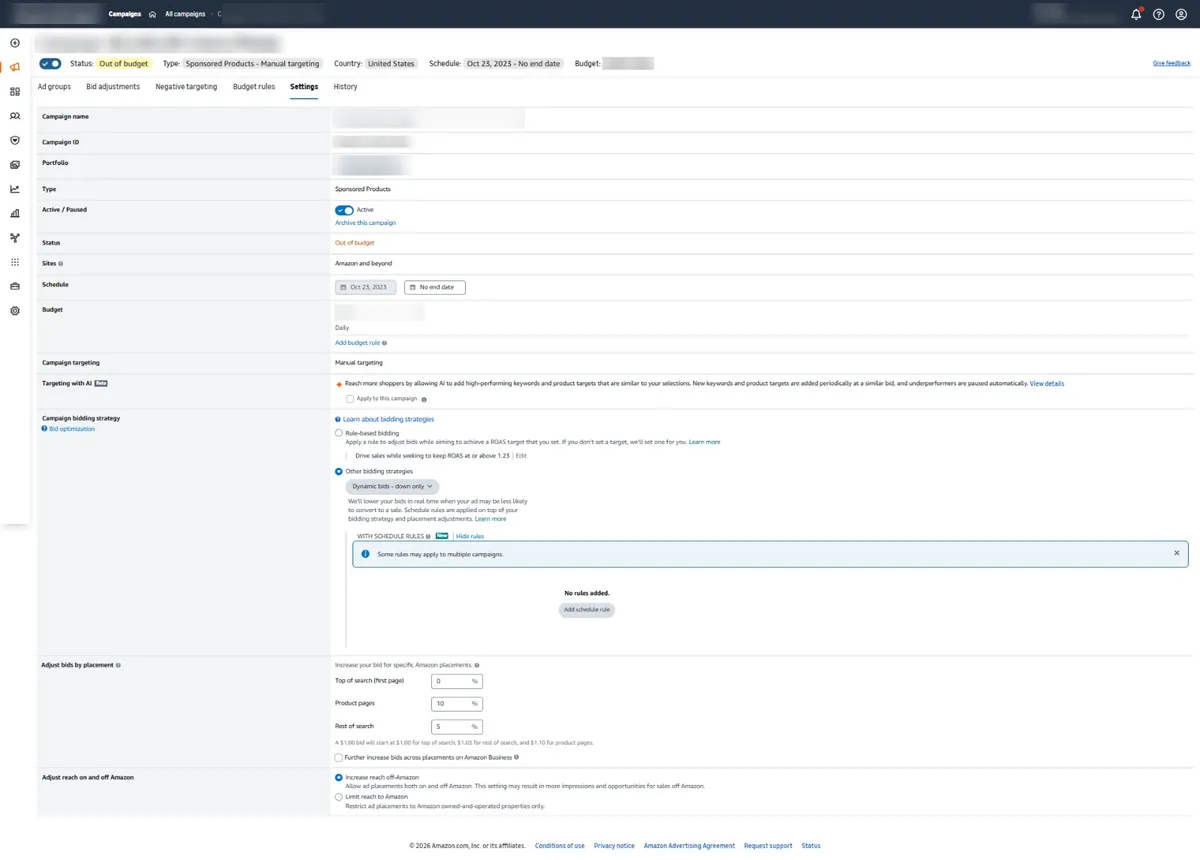
Sponsored Products are cost-per-click ads that promote individual product listings. Amazon says they can appear at the top of, alongside, or within shopping results and on product pages, and on select Amazon-owned and third-party sites and apps (Amazon Ads, Sponsored Products). A click takes the shopper to the product detail page.
You can target in two ways:
- Automatic targeting. Amazon’s systems match your ad to relevant searches and products.
- Manual targeting. You choose the keywords or products (ASINs) yourself.
Sponsored Products are a common starting point. Professional sellers, vendors, KDP authors and agencies can use them (Amazon Ads).
Sponsored Brands
Sponsored Brands ads show your brand, not just one product. Amazon describes formats using video, images or product collections, appearing in placements like the top of search and product pages, and sending traffic to a Brand Store or a detail page (Amazon Ads, Sponsored Brands).
For sellers, Sponsored Brands require enrollment in Amazon Brand Registry. In Amazon’s setup steps, a submitted ad “will be reviewed within 72 hours” (Amazon Ads, Sponsored Brands).
Sponsored Brands also give you new-to-brand metrics: orders from first-time customers of your brand over a 12-month look-back. Amazon notes first-time purchases often cost more than repeat ones, so ACOS alone can undersell these campaigns.
Amazon Advertising Sponsored Display (Now “Display Ads”)
Amazon advertising Sponsored Display has changed. Amazon says Sponsored Display is part of its display ads offering, inside a platform it calls Amazon Ads Agent that brings sponsored ads and Amazon DSP workflows into one workspace (Amazon Ads, Sponsored Display). Per Amazon:
- Existing Sponsored Display campaigns keep running.
- You find them under “Display, Video, and Audio” campaigns.
- New display campaigns are created from Campaigns → Create Campaign → Display, Video, and Audio → Display.
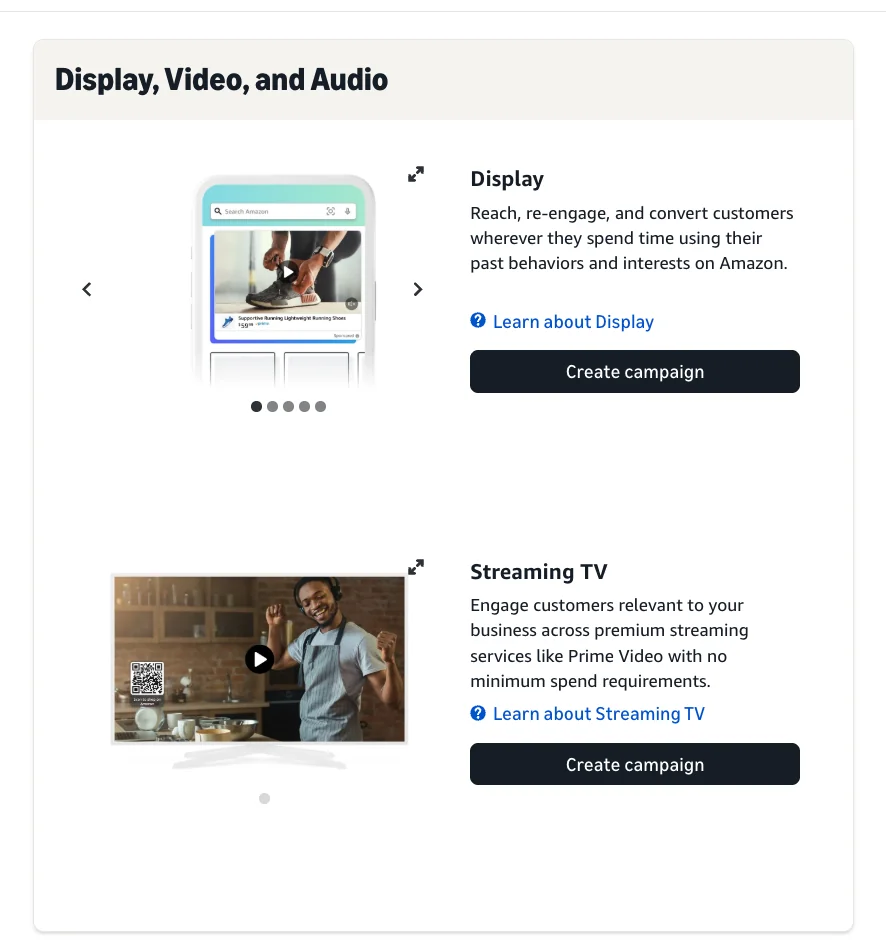
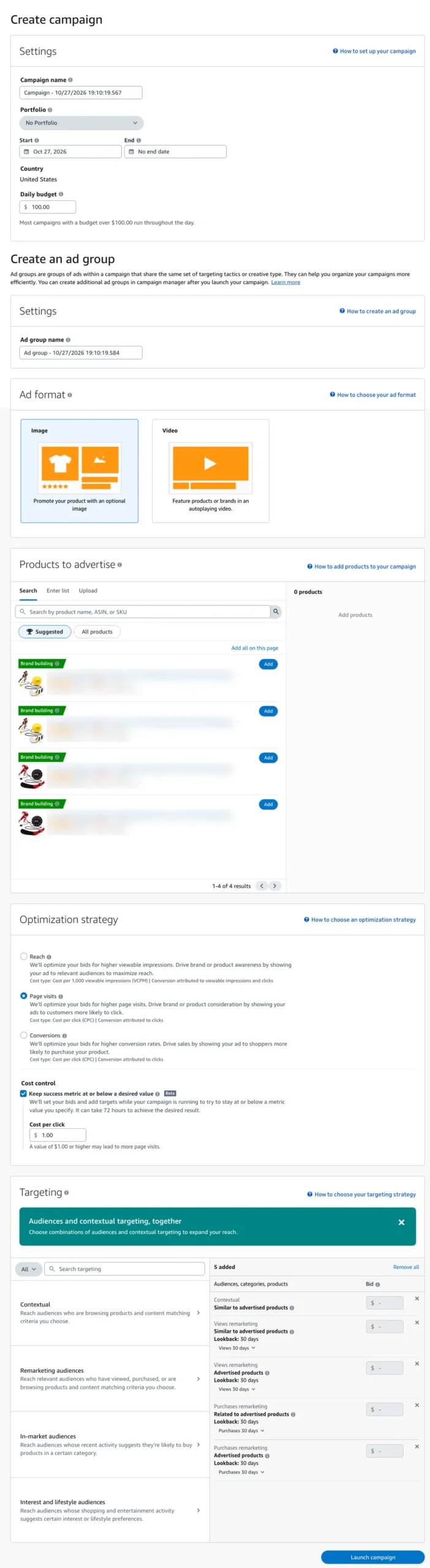
Amazon says display ads reach customers across Amazon properties, including Twitch, Fire TV and Echo Show, and premium open-internet placements. The Ads console describes Display as a way to “reach, re-engage, and convert customers” using their past behaviors and interests on Amazon, and offers remarketing audiences of shoppers who viewed or purchased products.
Amazon DSP
Amazon DSP (demand-side platform) was Amazon Ads’ programmatic solution for display, video, audio and streaming TV ads across Amazon properties and third-party publishers. Amazon now says it has evolved into Amazon Ads Agent, with its programmatic capabilities in Display, Video, and Audio campaigns (Amazon Ads, Amazon DSP).
How Much Does Amazon Advertising Cost?
How much does Amazon advertising cost? There is no set price. You set it, within an auction. Amazon says it has priced clicks using a form of generalized “second-price” auction, which means advertisers may pay less than their bid (Amazon, response to the FTC’s lawsuit regarding Sponsored Ads).
There is no fixed Amazon advertising fee schedule
People search for an “Amazon advertising fee schedule” expecting a rate card. For sponsored ads there isn’t one. Amazon states that “Sponsored Products campaigns have no monthly or upfront fees” and that you bid the maximum amount you are willing to pay when a shopper clicks (Amazon Ads, Sponsored Products).
Your real cost is:
Clicks × the cost of each click
A higher bid makes your ad more likely to show when it matches a search.
How budgets work
Amazon explains that the daily budget is averaged over a calendar month. Its example: a $100 daily budget can produce up to $3,100 of clicks in a 31-day month. Budgets are not paced through the day, so a small one can run out in minutes when demand is high, but total spend will not exceed what you set for the campaign’s duration (Amazon Ads, Sponsored Products).
Sponsored Brands pricing models
Sponsored Brands are not CPC only. Amazon lists three pricing models depending on your goal (Amazon Ads, Sponsored Brands):
- Cost per click (CPC) for driving page visits.
- Cost per 1,000 viewable impressions (vCPM) for growing brand impression share.
- Fixed, upfront pricing with reserve share of voice, which secures top-of-search placement for your branded keywords. This one requires a minimum spend commitment.
There is no minimum spend for CPC or vCPM campaigns, and you can adjust bids or pause at any time.
What actually drives your cost per click
We will not quote averages, because they vary by category, season and marketplace. The levers:
- Competition on the keyword. More bidders on a term push the price up.
- Match type and targeting. Amazon offers broad, phrase and exact match for keywords (Amazon Ads, Sponsored Products targeting guide). Broad buys more unintended clicks; exact buys fewer, more relevant ones.
- Conversion rate. A listing that converts can afford a higher bid at the same ACOS.
- Seasonality. Peak events tend to raise competition (see the example below).
The metrics to watch are ACOS (ad spend ÷ ad sales), ROAS (ad sales ÷ ad spend) and TACoS (ad spend ÷ total sales). TACoS tells you whether ads are lifting the whole business or just buying back sales you would have made anyway.
Example (illustrative numbers, not a client result): A product pays a $1.00 CPC at a 25% ACOS. Before a peak event, CPC rises to $1.30. With conversion unchanged, ACOS rises to about 33%. If the event lifts conversion by 30%, ACOS returns to about 25% even with CPC at $1.30.
What Is the Amazon Advertising Console?
The Amazon advertising console is the self-serve interface for creating campaigns, setting bids and budgets, and pulling reports. Amazon’s getting-started guide says to sign in to your advertiser account, click “sponsored ads,” then “campaign manager” from the left-hand menu (Amazon Ads, Understanding Amazon Ads). In Seller Central, click Marketing, then Ads console from the left-hand menu.
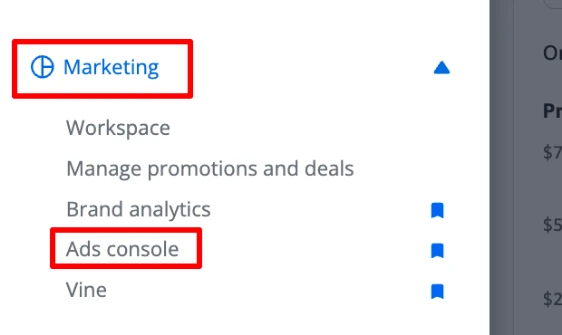
Inside it, the structure looks like this:
- Portfolio (optional): a folder of campaigns, often by brand or product line, with an optional budget cap.
- Campaign: ad type, daily budget, bidding strategy, dates.
- Ad group: a set of products sharing targeting.
- Targets: keywords or products, each with a bid.
- Negative targets: searches or products you exclude.
Amazon’s Sponsored Products setup follows this order: create a campaign, choose Sponsored Products, add products, define targeting and bidding, then name it, set dates and a daily budget, and launch (Amazon Ads).
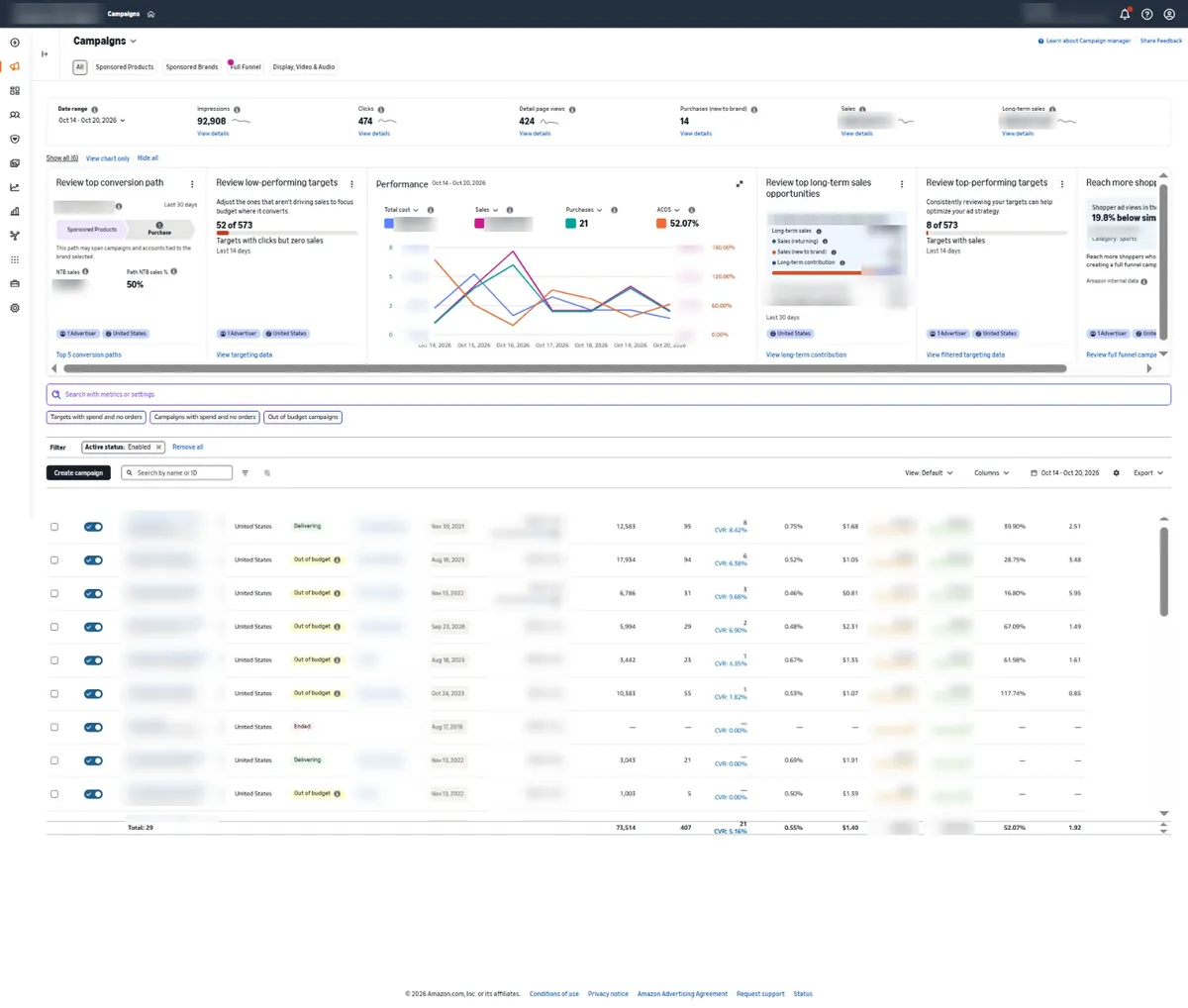
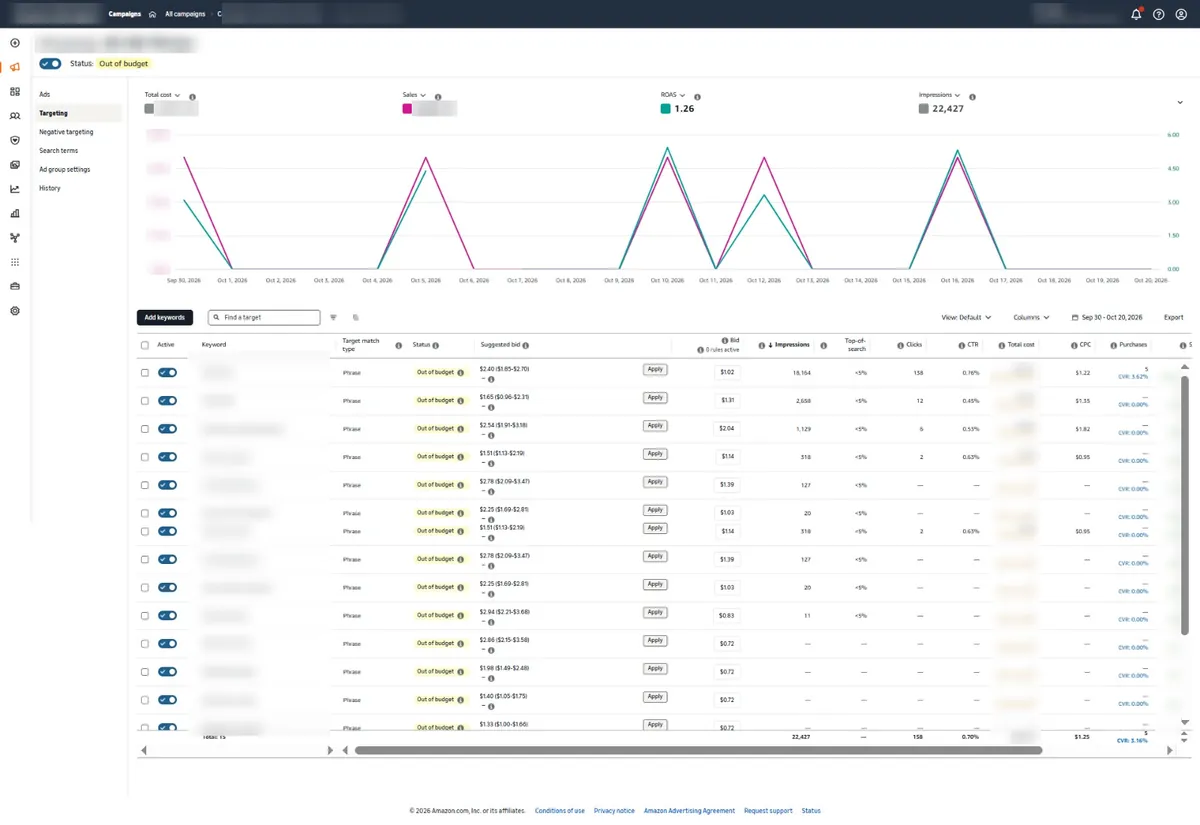
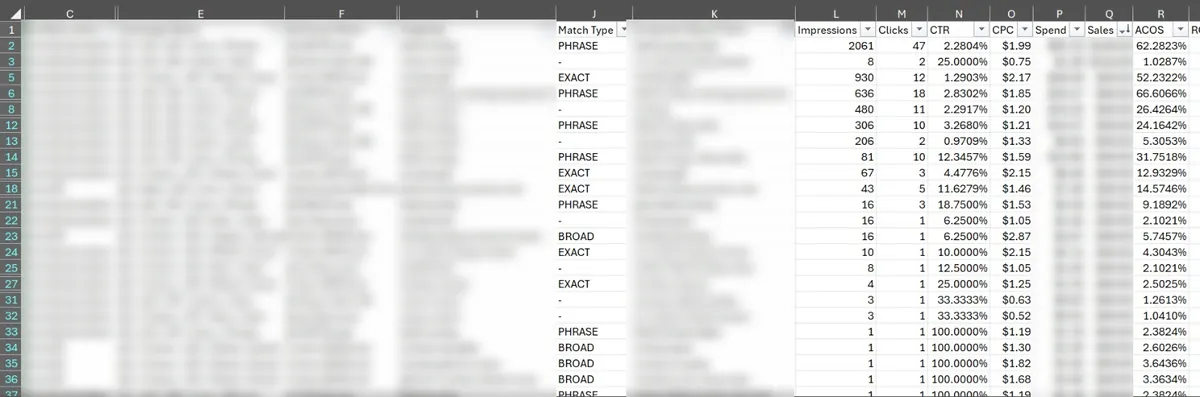
Reporting shows search terms, placements and product-level performance. The search term report shows what shoppers typed before clicking, so you can promote winners to exact match and add losers as negatives.
The Amazon Advertising Flywheel
The Amazon advertising flywheel is the loop where ads drive sales, those sales build a sales history, and better organic rank brings more sales without paying for every click. Amazon does not publish its ranking algorithm itself, but it openly tells sellers what it rewards in a good product: sales, conversion and relevance.
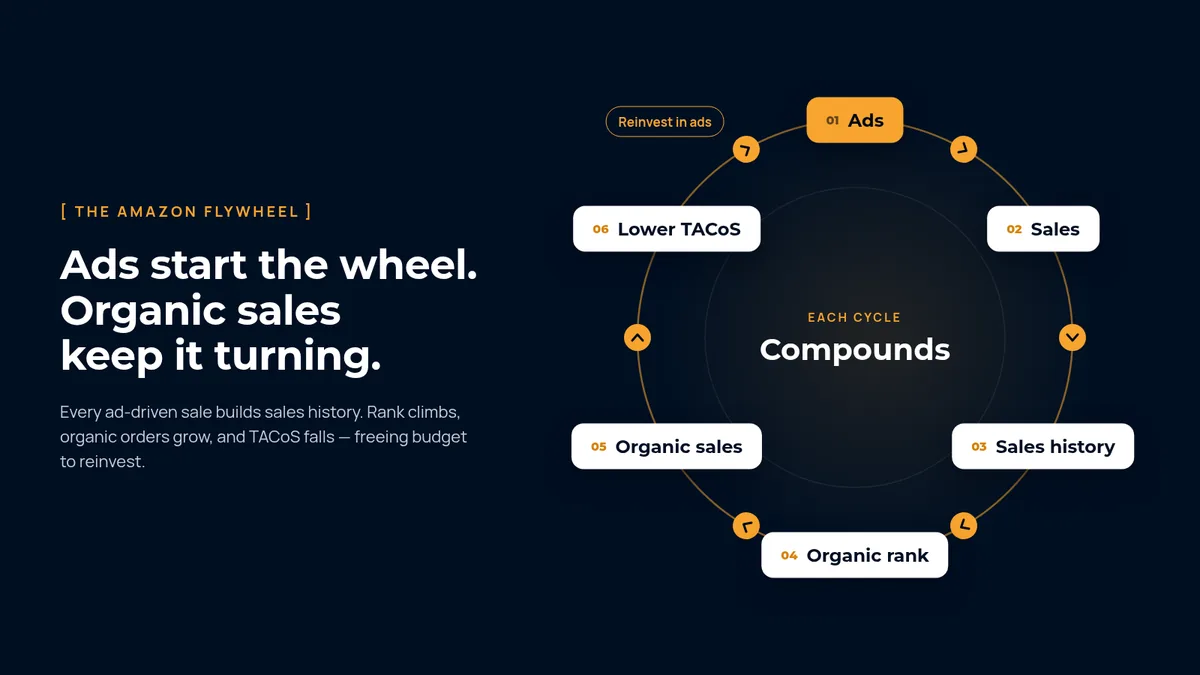
- Ads. Ads put the product in front of shoppers.
- Sales. Clicks turn into sales, if the listing converts.
- Sales history. Consistent sales on a keyword signal relevance. More orders bring more reviews over time, which lifts conversion further.
- Organic rank. The product starts appearing higher in unpaid results for the terms it has been selling on.
- Organic sales. You get sales you did not pay a click for.
- Lower TACoS. As organic sales take a bigger share of total sales, ad spend as a share of total sales falls. That frees budget to reinvest in ads: on the next keyword, the next product, or a defense campaign to protect what you have won. Then the wheel turns again.
The flywheel only turns if the listing converts. Clicks to a weak page do not stick. That is why we treat Amazon SEO and listing optimization as part of the ad plan.
Turning ads off can also hurt: if ad-driven sales supported organic rank, rank can slip once they stop.
Example (illustrative numbers, not a client result): A brand sells $100,000 in a month, $60,000 of it from ads, on $20,000 of ad spend: ACOS 33%, TACoS 20%. Three months later, ad spend and ad sales are unchanged but total sales are $120,000. ACOS is still 33%, yet TACoS is about 17% and organic share has risen from 40% to 50%.
Best Amazon Advertising Strategy: A Practical Starting Structure
There is no single best Amazon advertising strategy, but profitable accounts share a shape.
1. Fix the listing first. Make sure the product is in stock, holds the Featured Offer and converts.
2. Start with Sponsored Products, auto and manual together. Auto finds search terms you did not think of; manual controls the terms you know matter.
3. Harvest search terms weekly. Move converting terms from auto into manual exact match. Add non-converting spenders as negatives.
4. Separate branded and non-branded traffic. Branded searches usually convert well; non-branded drives growth.
5. Defend your product pages. Target your own ASINs so competitors are not the only ads on your detail page.
6. Add Sponsored Brands once you have Brand Registry and enough products for a collection or video.
7. Add display ads for retargeting once your core search campaigns are stable.
8. Judge on TACoS and profit, not ACOS alone.
Our campaign naming template is AC | Product | Ad Type | Objective | Targeting, with an optional last part for a variant. For example: AC | Trainer | SP | Core | Exact.
If you would rather have a team run this, our Amazon PPC management services cover Sponsored Products, Sponsored Brands and display campaigns, managed to profit rather than spend.
How to Learn Amazon Advertising
To learn Amazon advertising yourself, start with Amazon’s own material. Its Sponsored Brands page links a beginner learning path of about an hour and a half (Amazon Ads, Sponsored Brands). Then:
- Launch one small Sponsored Products campaign on your best seller.
- Read the search term report every week.
- Change one thing at a time and record it.
FAQ
How much does Amazon advertising cost?
There is no fixed price. Sponsored Products charge per click, with no monthly or upfront fees, and you set the maximum bid and daily budget (Amazon Ads). Sponsored Brands can also be bought on vCPM or fixed-price reserve share of voice (Amazon Ads).
Is there an Amazon advertising fee schedule?
Not for sponsored ads. Cost comes from the auction and your bids and budgets.
What is the Amazon advertising console?
The self-serve interface for campaigns, bids, budgets and reports.
What happened to Amazon Sponsored Display?
Amazon folded Sponsored Display into display ads. Existing campaigns keep running under “Display, Video, and Audio,” and new ones are created there (Amazon Ads).
What is the Amazon advertising flywheel?
The loop where ads drive sales, sales and conversion improve organic rank, and higher rank brings unpaid sales. As organic share grows, TACoS falls and the savings can be reinvested. It only works when the listing converts.
